York
08:00 AM - 05:00 PM
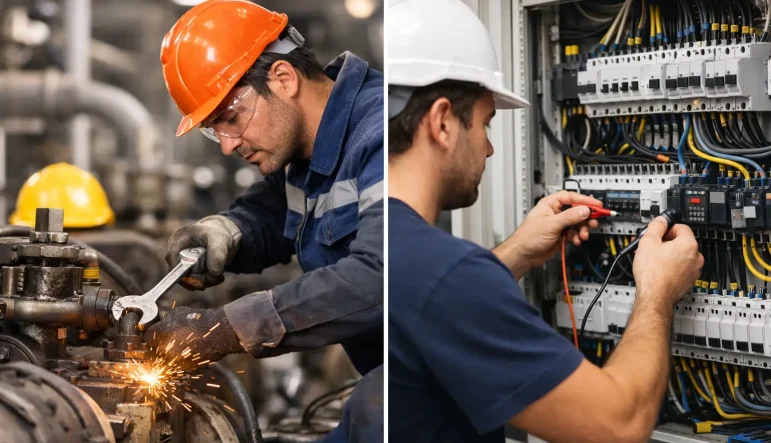
A production line that stops twice a month tells you one thing. A distribution board that no longer supports added load tells you another. That is where industrial maintenance vs electrical upgrades becomes a practical decision, not a technical label. One is about keeping existing systems safe, reliable and serviceable. The other is about changing capability, capacity or compliance where the current installation no longer fits the job.
For facilities managers, site owners and procurement teams, the difference matters because the budget line, downtime risk and project scope are not the same. Treat an upgrade like routine maintenance and the site may keep absorbing faults, inefficiencies or capacity limits. Treat maintenance issues as a trigger for major capital works too early and you can overspend without solving the underlying operational problem.
Industrial maintenance covers the planned and reactive work needed to keep electrical systems operating as intended. That includes inspections, testing, fault-finding, repairs, component replacement, thermal checks, cleaning of critical equipment, and servicing of panels, controls and distribution equipment. The purpose is not to transform the installation. It is to preserve safe performance and reduce unplanned failure.
Electrical upgrades go further. An upgrade changes the installation to improve capacity, safety, efficiency, functionality or compliance. That might involve replacing an outdated distribution board, increasing supply capacity, modernising lighting and controls, upgrading earthing arrangements, renewing containment, or integrating newer plant requirements into an older system. In simple terms, maintenance preserves. Upgrades improve or expand.
That sounds clear enough on paper, but real sites rarely present neat categories. A failing switchgear assembly may begin as a maintenance issue. If replacement parts are obsolete, fault levels have changed or the panel no longer meets current operational needs, the right answer may become an upgrade.
Maintenance is usually the correct route when the system is fundamentally suitable for the building or process and the issue is condition, wear or isolated failure. On a well-designed site, cables, protective devices, motors, control gear and accessories all have service lives. Some degrade slowly. Others fail with little warning. Planned maintenance exists to identify those risks before they become outages or safety events.
In industrial settings, maintenance often makes the most commercial sense where production depends on stable operation and equipment remains fit for purpose. Replacing worn contactors, tracing nuisance tripping, tightening terminations, testing emergency lighting, inspecting machinery supplies and checking protective coordination are all maintenance-led tasks. They protect continuity without forcing wider system change.
There is also a compliance dimension. Regular inspection and testing supports duty holders in demonstrating that installations are being managed responsibly. For many sites, especially those with ageing infrastructure, a maintenance programme provides the evidence base needed to prioritise future works sensibly rather than guessing where money should go.
The trade-off is that maintenance does not solve design limitations. If your load profile has changed, your process has expanded or your existing installation was only ever adequate for a previous phase of use, maintenance can only carry you so far.
Electrical upgrades are usually justified when the installation no longer matches the site’s operational demands, legal obligations or resilience expectations. That may be because the business has grown, equipment has changed, or the consequences of electrical failure are now more serious than they were when the system was first installed.
Capacity is one of the clearest drivers. If a facility has added machinery, EV charging, HVAC plant, data infrastructure or specialist process equipment, the original electrical design may be under strain. You may see overloaded circuits, recurring breaker trips, poor power quality or awkward temporary workarounds. At that point, continued maintenance of an undersized system is often false economy.
Obsolescence is another common trigger. Older boards and control systems can remain operational for years, but parts availability becomes a risk. Once replacement components are difficult to source, every fault takes longer to resolve and carries more uncertainty. An upgrade can reduce downtime risk and improve serviceability, even before a serious failure occurs.
Then there is compliance. Regulations, standards and insurance expectations do not stand still. Not every older installation must be replaced simply because newer standards exist, but where deficiencies create real safety concerns or prevent safe adaptation of the site, upgrade work becomes the responsible choice.
Most clients do not need a lecture on definitions. They need to know what to do when a site is still running, but confidence in the installation is slipping. This is where surveys and condition-led assessment matter.
A recurring fault does not always mean a major upgrade is required. It could be poor termination, localised heat damage, environmental contamination or a single failing device. Equally, replacing the same category of component again and again may be a sign that the wider system is no longer suitable.
This is why industrial maintenance vs electrical upgrades should be judged against evidence, not habit. Load studies, inspection results, fault history, thermal imaging, age profile, spare parts availability and production criticality all help establish whether the issue is deterioration or mismatch. The right contractor should be able to separate those two with clear reasoning.
Cost is often the first question, but it should not be the only one. Maintenance usually has the lower immediate price because it addresses specific defects and can often be scheduled around operations. Upgrades tend to require more planning, possible shutdown windows, design input and staged implementation.
However, the cheaper option upfront is not always the lower-cost option over time. If reactive callouts are increasing, if failures are interrupting output, or if ageing infrastructure forces expensive temporary fixes, a series of maintenance events can become more costly than a planned upgrade. The same applies where a lack of capacity is holding back operational change.
Downtime planning also differs. Good maintenance can often be completed in shorter windows, sometimes out of hours or in sections. Upgrades may require isolations, commissioning and coordinated works with other contractors or departments. But planned upgrade downtime is still preferable to unplanned outage, especially in manufacturing, transport and high-occupancy commercial environments.
The practical question is not just, “What will this job cost?” It is, “What is the cost of staying as we are?”
The strongest decisions usually start with a proper electrical survey rather than assumptions from either side. Facilities teams often know where the pain points are, but a technical assessment translates those problems into scope.
A good survey should look at installation condition, loading, compliance issues, resilience requirements and future use. That last point is often missed. If the site is likely to add plant, reconfigure space or increase occupancy within the next few years, maintenance-only decisions can become short-lived.
It also helps to prioritise by consequence. Some defects need immediate repair because they present a clear safety or continuity risk. Some systems are stable enough to maintain for now but should be earmarked for later upgrade. Others justify immediate investment because they are already constraining the business.
For mixed-use estates or organisations with multiple properties, this can become a phased plan rather than a single project. That is often the most sensible route. It keeps urgent risks under control while aligning larger upgrades with budget cycles and operational windows.
Industrial sites rarely operate in isolation from wider building systems, compliance duties and workforce responsibilities. The contractor assessing a warehouse, plant room, transport facility or commercial unit needs to understand not only installation work, but how that work affects safety procedures, documentation and ongoing operation.
That is where a service-led provider with survey, installation and training capability can add real value. The technical answer may be straightforward. The delivery answer is usually more complex. Method statements, shutdown planning, handover records, staff awareness and future maintenance arrangements all influence whether the work improves reliability in practice.
For clients working across industrial, commercial and infrastructure environments, consistency matters as much as technical skill. An approved contractor should be able to assess what is there, recommend only what is necessary, and carry out the work to a standard that stands up to operational scrutiny.
Sometimes the choice is not one or the other. It is maintenance now, upgrade later. In other cases, targeted upgrades within a broader maintenance strategy deliver the best result. Replacing a critical board, improving local distribution and retaining serviceable areas of the installation may be more practical than a full renewal.
The point is to make decisions based on condition, risk and future demand rather than on labels. Industrial maintenance keeps serviceable systems dependable. Electrical upgrades prepare a site for what its current installation cannot safely or efficiently support. Both have a valid place.
If your site is showing signs of strain, recurring faults or changing power demands, the most useful next step is not to guess which category the work belongs in. It is to get a clear technical picture of what the installation can still do, what it should no longer be asked to do, and what needs to change before the next failure makes the decision for you.

Choose PAT testing courses that build practical competence, support wo

Citroën has unveiled ë-Berlingo, the latest version of its multi-awa
