York
08:00 AM - 05:00 PM
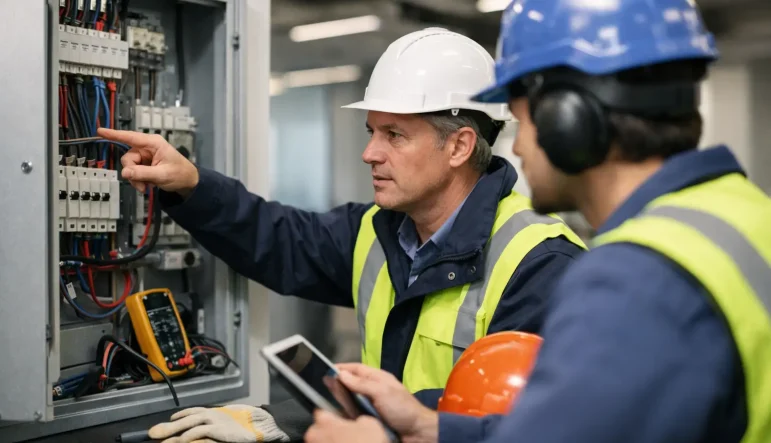
A near miss at a consumer unit, an overloaded extension lead in a back office, a contractor isolating the wrong circuit on a live site – most electrical incidents do not begin with dramatic failure. They start with gaps in knowledge. That is why workplace electrical training requirements matter for any employer responsible for people, premises and equipment.
For some businesses, the need is obvious. Industrial sites, transport settings and plant rooms carry clear electrical risk. For others, the exposure is easier to overlook. Offices, rental properties, schools, retail spaces and shared commercial units still rely on fixed installations, portable equipment and safe systems of work. Training is not only for electricians. It is for anyone whose role brings them into contact with electrical hazards, even if only occasionally.
In practical terms, workplace electrical training requirements are about competence. Employers must ensure that employees have the information, instruction, training and supervision needed to work safely. The exact training required depends on the task, the environment and the level of risk.
That means there is no single course that covers every workplace. A facilities operative resetting breakers in a commercial building does not need the same level of training as a qualified electrician carrying out fault finding. Equally, a member of office staff should not be expected to understand detailed testing procedures, but they should know how to spot obvious defects, report damaged equipment and avoid unsafe use of extension leads and adaptors.
The common mistake is treating electrical training as a one-off certificate. In reality, it should sit within a wider safety system that includes risk assessment, clear responsibilities, safe isolation procedures, equipment maintenance and refresher training where needed.
Anyone who may be exposed to electrical risk needs an appropriate level of training. The word appropriate matters. Training should match the person and the work rather than being applied too broadly or too lightly.
For general staff, this may be basic electrical safety awareness. They need to recognise signs of damage, know not to use unsafe equipment, understand how to report concerns and avoid interfering with installations they are not authorised to touch.
For maintenance staff, caretakers, site supervisors and facilities teams, the requirement is usually higher. These roles often involve first-line response to faults, isolation of equipment, access to plant areas or oversight of contractors. They need clearer understanding of risk controls, permit systems and the limits of their own authority.
For electrically skilled persons, training becomes more specialised. This may include inspection and testing, safe isolation, fault diagnosis, working on or near live equipment where justified, and knowledge of the relevant standards and procedures for the type of installation involved.
Contractors also need attention. Bringing in an external team does not remove the duty to manage electrical risk on site. Employers still need to verify competence, clarify responsibilities and ensure that local procedures are understood.
UK employers are not usually looking for training for its own sake. They want to know what keeps them compliant and what stands up if something goes wrong.
The legal position is fairly straightforward in principle. Employers have duties under health and safety law to protect employees and others from foreseeable risk. For electrical work, that includes providing suitable training and ensuring work is carried out by people who are competent for the tasks assigned.
The difficulty is that competence is not defined by a single badge. It is judged by a mix of training, experience, technical knowledge and the ability to apply safe working practices in the real environment. A person may be competent for one task and not for another. That is why a blanket approach often fails under scrutiny.
If a business runs multiple sites, the picture becomes more complex. An office fit-out, a warehouse distribution centre and a transport facility may all have different electrical systems, access controls and operational constraints. Training should reflect that reality. Generic awareness has value, but site-specific instruction is often where the real risk reduction happens.
Good training is clear, relevant and tied to actual duties. It should not be overloaded with technical detail that the learner will never use, but it cannot be so general that it has no effect on behaviour.
At a basic level, good training covers electrical hazards, common unsafe conditions, emergency response, reporting arrangements and the limits of what unqualified staff must not do. This is especially useful in workplaces where people regularly use portable appliances, charging equipment or temporary power arrangements.
For higher-risk roles, the content should be more structured. Safe isolation is a common example. Many incidents occur not because staff have never heard of isolation, but because they follow an incomplete version of it. Training needs to cover the sequence properly, confirm what equipment is suitable, and make clear when escalation is required.
It should also be supported by local procedures. A well-trained employee can still be put at risk if lock-off devices are missing, labels are unclear, distribution boards are poorly identified or contractor controls are weak. Training is one part of the control measure, not the whole measure.
Different settings need different emphasis. In domestic property management, the focus may be on recognising defects, understanding landlord duties, arranging inspection intervals and managing contractor attendance safely. The risk profile is usually lower than on an industrial site, but the consequences of poor decisions can still be serious.
In commercial premises, electrical training often centres on facilities management, small works, portable equipment use and coordination between tenants, maintenance teams and contractors. Busy buildings create practical challenges. Equipment gets moved, temporary supplies appear, and reporting lines can become blurred.
Industrial environments generally require a more formal approach. There may be three-phase systems, machinery, process equipment, shutdown activity and higher fault energy. Here, competence, authorisation and supervision need tighter definition. Informal assumptions are not enough.
Transport and infrastructure settings bring another layer of control. Operational continuity, restricted access, public safety and complex asset interfaces all affect the training requirement. In these environments, the standard of competence management typically needs to be higher because the margin for error is smaller.
The sensible starting point is the work itself. What are people actually doing, what electrical hazards are present, and where could poor judgement lead to injury, fire, equipment damage or service interruption?
From there, employers can group roles by exposure and responsibility. Not everyone needs the same course, but everyone does need a level of instruction proportionate to risk. That often means separating awareness training for general staff from task-specific training for maintenance personnel and technical teams.
Records matter as well. If training has been delivered, it should be documented, reviewed and refreshed when equipment, processes or staff responsibilities change. This is particularly important after site alterations, new installations or incident investigations.
There is also a judgement call around frequency. Annual refreshers may be sensible for some roles, while others may need updates only when duties change. The right answer depends on turnover, complexity and the pace of operational change.
One common gap is assuming that experienced staff do not need formal refresher training. Experience is valuable, but habits can drift away from current procedure, especially in environments where tasks are done under time pressure.
Another is relying too heavily on toolbox talks or induction briefings. These are useful, but they are not always enough to demonstrate competence for higher-risk work. They work best when supporting a structured training and authorisation process.
A third issue is poor alignment between training and site reality. Staff may complete a course, then return to a workplace with unclear circuit identification, mixed responsibilities and no practical supervision. In that situation, the training has not failed by itself, but the system around it has.
This is where an experienced contractor and training provider can add value. A business such as SJB Smart Electricals can assess the environment as well as the people, which helps training connect to real operating conditions rather than staying theoretical.
There is a line employers need to hold clearly. Training staff in electrical safety does not turn them into electricians. It gives them the knowledge to work within defined boundaries and to recognise when specialist support is required.
That distinction protects both safety and compliance. Businesses sometimes try to solve cost pressure by pushing minor electrical tasks onto staff who are not properly equipped for them. The short-term saving rarely justifies the long-term risk. If the work requires technical diagnosis, alteration of fixed wiring or formal testing, it should sit with a competent electrical professional.
A well-run workplace uses training to improve judgement, reporting and safe behaviour. It does not use training as a workaround for inadequate resourcing.
Electrical safety at work is rarely about one dramatic decision. More often, it is the result of everyday standards being either maintained or allowed to slip. When training is matched properly to the task, the site and the people involved, it becomes a practical control measure that supports safer work, stronger compliance and fewer costly surprises.

Citroën has unveiled ë-Berlingo, the latest version of its multi-awa

Polestar is embracing the connected nature of Polestar 2 with the avai
