York
08:00 AM - 05:00 PM
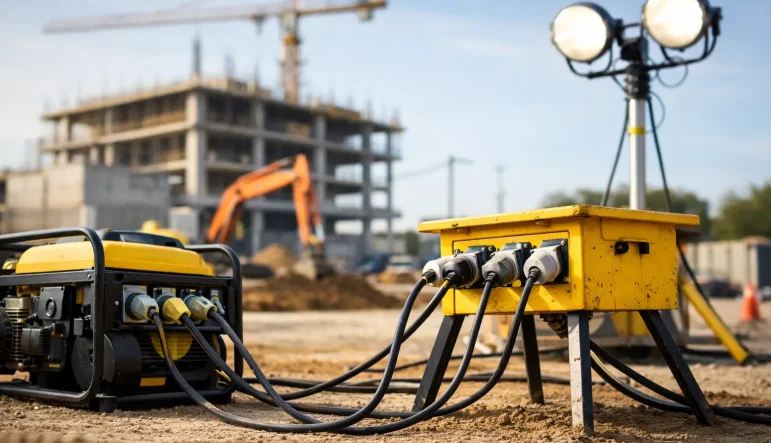
A site can have ground broken, plant delivered and trades booked in, yet still lose days before meaningful work starts because the electrical setup was treated as an afterthought. Temporary power for construction sites is one of the first systems that needs proper planning, not only to keep the programme moving, but to protect people, equipment and the wider project from avoidable risk.
For smaller jobs, clients sometimes assume a temporary supply is little more than a board and a few sockets. On larger commercial, industrial or infrastructure works, the picture changes quickly. You may need welfare units, lighting, charging points, pumps, security systems, site cabins and specialist tools all running from a supply that is safe, correctly distributed and suitable for changing site conditions. That is where technical judgment matters.
Electrical demand on a construction project rarely stays fixed. At the start, the focus may be perimeter security, welfare and basic hand tools. As the programme develops, heavier equipment, temporary lighting, drying systems or testing equipment can alter the load profile substantially. If the original setup was undersized, poorly positioned or loosely designed, the result is usually nuisance tripping, overloaded circuits, cable damage or costly changes under pressure.
Early planning gives the project team time to assess what is actually required rather than what is merely convenient in the first week. That means looking at load calculations, access routes, distances, environmental conditions and the likely sequence of trades. A temporary installation should support the job as it develops, not force the job to work around its limitations.
There is also a compliance issue. Temporary electrical systems on building sites are not exempt from standards simply because they are temporary. They still need to be designed, installed, inspected and managed correctly. The duty of care remains the same.
The exact arrangement depends on the size and nature of the project, but most temporary site supplies start with a source of power and a safe means of distribution. That source may be an existing mains connection, a new temporary utility connection or a generator-based solution where mains access is not yet available.
From there, the installation often includes a main distribution point, sub-distribution boards, weather-appropriate sockets, site lighting, earthing and bonding provisions, cable management and protective devices selected for the actual use case. Welfare cabins and offices may need separate arrangements from plant or tool circuits. In some cases, metering or monitoring is also useful, particularly where energy use needs to be tracked across phases of the project.
Good setup is not just about getting power to the far end of the site. It is about making sure circuits are clearly identified, equipment is suitable for site conditions and access for inspection, maintenance and emergency isolation is properly considered.
This depends on programme, location and load.
Where a temporary mains connection is available early enough, it is often the more practical long-term choice. It can provide greater stability, lower ongoing fuel handling requirements and fewer operational interruptions than a generator-led arrangement. For projects with a longer duration, that can make a real difference to running costs and day-to-day site management.
Generators can still be the right answer where the site is remote, where utility connections are delayed or where the power demand is highly specific. They offer flexibility, but they also come with additional considerations. Fuel storage, refuelling logistics, noise, emissions, security and maintenance all need managing. If the generator is not sized correctly, efficiency and reliability can suffer. Too small and it struggles under load. Too large and it can run inefficiently, particularly on lighter demand.
On some projects, a hybrid approach is sensible. A generator may support early works until a mains connection is live, or it may provide backup resilience for critical operations.
Residual current protection, circuit breakers and suitable distribution equipment are essential, but they are only part of the picture. Construction sites are hard on electrical systems. Cables get dragged, crushed, exposed to weather and moved repeatedly as work fronts change. Temporary equipment that was safe on installation day can become unsafe if it is not monitored as the site evolves.
That is why layout and cable routing matter. Trailing leads across vehicle routes, poorly protected connections and distribution boards placed in vulnerable positions create predictable hazards. The safest design is usually the one that reduces opportunities for damage and misuse in the first place.
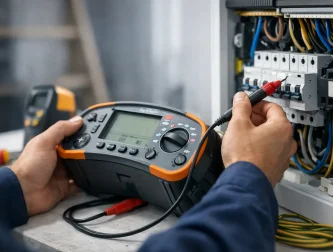
Inspection and testing also need to be taken seriously. Temporary installations should be checked at appropriate intervals, and any additions or alterations should be assessed properly rather than improvised by whoever needs another socket. In practice, many site electrical problems start with informal changes made under time pressure.
For decision-makers, this is where using a competent contractor protects more than compliance. It helps reduce downtime, prevent repeated faults and avoid the kind of electrical issue that disrupts multiple trades at once.
Most site power failures are not especially mysterious. They usually come back to poor planning, unsuitable equipment or weak control over changes.
One common issue is underestimating load. A site that begins with chargers and small tools may later add heaters, drying equipment or larger plant, placing demands on circuits that were never intended for that level of use. Another is poor segregation, where welfare, office and operational loads are mixed in a way that makes isolation and fault finding harder than it needs to be.
Cable management is another recurring problem. If cables are left exposed to traffic routes, standing water or sharp edges, deterioration is a matter of time. Likewise, temporary lighting is often treated as secondary, even though poor lighting increases the likelihood of accidents and can affect work quality during darker periods.
Then there is documentation. If nobody has a clear record of the temporary arrangement, extensions and alterations become harder to control. On a busy site, that lack of clarity can lead to unsafe assumptions.
A competent electrical contractor will start with the job itself. That means understanding site use, duration, sequence, likely load changes and any unusual environmental or operational constraints. A domestic refurbishment, a warehouse fit-out and a rail-adjacent project do not call for the same temporary power strategy.
From there, the design and installation should reflect both current demand and foreseeable changes. Boards need to be appropriately rated and located. Protection must suit site conditions. Routes for cables and equipment should be practical for real working environments rather than idealised drawings. Just as importantly, there needs to be a clear process for inspection, maintenance and future modification.
This is where service-led contractors bring value. They do not simply install and walk away. They assess, implement and support the setup as part of a wider project requirement. For clients managing compliance, operational risk and programme pressure at the same time, that joined-up approach is often the difference between a temporary system that functions and one that genuinely supports delivery.
SJB Smart Electricals works in exactly that practical space, where technical accuracy, approved working standards and dependable delivery matter across varied environments.
Before agreeing any temporary electrical arrangement, it is worth asking a few direct questions. How much power is needed now, and what is likely to be needed later? Is the chosen source realistic for the programme? How will distribution change as the site develops? Who is responsible for inspection and testing? What happens when extra cabins, plant or work areas are added?
These are not paperwork questions. They affect cost, safety and whether the project can keep moving without repeated interruption. A cheaper initial setup can become expensive very quickly if it needs constant alteration or causes avoidable downtime.
It also helps to be clear about the handover from temporary to permanent systems. On some jobs, the transition is straightforward. On others, it needs careful coordination so that commissioning, energisation and live working boundaries are managed correctly.
That is the point many projects learn the hard way. A temporary electrical system may be in place for weeks or months, and during that time it supports live construction activity, multiple users and changing conditions. It deserves the same professional attention you would expect from any other critical installation.
When temporary power is planned properly, site teams notice it less – and that is usually a good sign. Tools work, cabins function, access remains safe and the job gets on with itself. If you are setting up a new project, the useful question is not whether you can get power on site quickly. It is whether you can get it in place safely, compliantly and in a way that will still make sense when the project gets busy.
Exploring multifunction testers gives teams reliable evidence on elect

Citroën has unveiled ë-Berlingo, the latest version of its multi-awa
