York
08:00 AM - 05:00 PM
A circuit labelled “off” is not necessarily dead. Incorrect labelling, backfeeds, shared supplies, standby generators and stored energy can all leave dangerous voltage present where a person expects safety. Safe isolation is therefore not a quick switch-off before work starts. It is a disciplined process for identifying the correct source of energy, securing it against reconnection and proving that conductors are dead before they are touched.
For homeowners, facilities managers and industrial duty holders alike, the principle is the same: electrical work must not begin on an assumption. The level of planning, documentation and control will vary between a domestic consumer unit and a complex industrial installation, but the risk of a mistaken isolation remains serious in every setting.
Safe isolation is the method used to make an electrical installation or item of equipment safe for work. It requires more than turning off a local switch, removing a fuse or relying on an indicator lamp. The person carrying out the work must isolate every relevant source of electrical energy, prevent inadvertent reconnection and verify the absence of voltage with suitable test equipment.
This approach supports the duties set out under the Electricity at Work Regulations 1989, including the expectation that systems are made dead before work is undertaken where this is reasonably practicable. It also reflects a straightforward reality from site work: a lock on the wrong isolator provides no protection at all.
The procedure should be planned around the actual installation. A small commercial board may have a clear single supply and circuit schedule. A plant room, rail environment or airport facility may involve multiple distribution boards, control circuits, emergency supplies, photovoltaic generation, battery storage or automatic changeover equipment. In those settings, isolation has to account for every possible route by which energy can return.
Although site rules and manufacturer instructions must always be followed, a competent person will normally work through a clear sequence. First, identify the equipment or circuit to be worked on and establish its normal supply arrangement. Drawings, circuit charts and labels are useful starting points, but they must be verified rather than accepted without question.
Next, identify all sources of supply. This can include the normal mains supply, alternative feeds, generators, UPS units, control transformers, solar PV systems and stored electrical or mechanical energy. Equipment that appears isolated at a local point may still be energised from elsewhere, particularly where controls, interlocks or monitoring circuits are involved.
The correct means of isolation is then operated. In many cases this will be an appropriately rated switch-disconnector, circuit-breaker or isolator designed to provide effective isolation. A control switch, emergency stop button or software command is not normally an isolation device. It may stop operation, but it may not disconnect the conductors or prevent automatic restart.
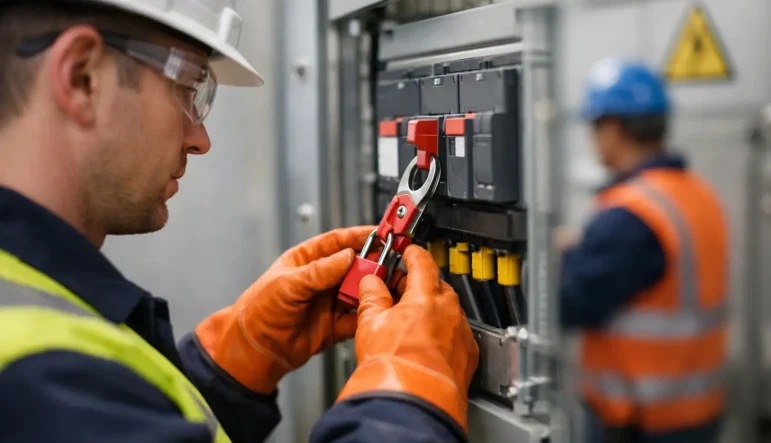
Once isolated, the device should be secured using a suitable lock-off arrangement. The key should remain under the control of the person undertaking the work. A warning tag should identify that work is in progress and make clear that the supply must not be restored. On larger sites, the locking and tagging arrangement may sit within a permit-to-work or formal isolation procedure.
The final and essential stage is proving dead. Use an approved, suitable voltage indicator to test the conductors at the point of work. Before the test, prove the indicator on a known live source or a proving unit. Test for voltage on all relevant conductors, including line-to-line, line-to-neutral and line-to-earth as appropriate. Then prove the indicator again immediately afterwards. This before-and-after check confirms that the tester was functioning when the absence of voltage was established.
Only after this sequence has been completed should work begin. If conditions change, the work is handed over, or there is any doubt about the isolation, the process should be revisited. Safe isolation is not a one-time formality; it remains a control throughout the task.
Lock-off is highly effective when it is applied to the correct point of isolation and combined with testing. On its own, however, it does not prove that the circuit is dead. A board may be incorrectly labelled, a circuit may be supplied from an unexpected direction, or a second supply may remain connected.
Voltage indicators and proving units are equally subject to strict requirements. A multimeter set to the wrong range, a damaged lead or a flat battery can create a false sense of security. For proving dead, a dedicated two-pole voltage indicator with appropriate leads and protection is generally the preferred tool. Test equipment must be suitable for the installation and maintained in good working order.
This is one reason why a non-contact voltage detector should not be used as the sole means of proving dead. Such devices can be useful as an additional indication, but they can respond unpredictably to induced voltages, screening and proximity effects. They do not replace a proper test with an approved voltage indicator.
Some installations demand additional controls because isolation is less straightforward. Solar PV systems can have live DC conductors whenever daylight is present, even after the AC supply has been isolated. Battery energy storage systems may retain hazardous voltage and may have separate battery, inverter and grid connections. Capacitors, variable speed drives and UPS equipment can hold stored energy after disconnection and may need a manufacturer-specified discharge period before testing.
Three-phase equipment introduces further considerations. A motor may be electrically isolated but still capable of movement due to gravity, pressure, stored mechanical energy or connection to another drive. Electrical isolation should therefore be coordinated with the wider safe system of work, including mechanical isolation where required.
In occupied commercial premises, the operational impact also matters. Isolating a circuit may affect fire alarms, security systems, data equipment, refrigeration, medical equipment or life-safety services. The correct response is not to avoid isolation, but to plan it properly: identify affected systems, notify relevant people, arrange temporary controls and schedule work at an appropriate time.
Safe isolation relies on people as much as equipment. The person carrying it out must understand the installation, recognise possible sources of supply, select appropriate test equipment and know when the situation falls outside their competence. This is especially relevant where older installations have incomplete labelling, alterations made by different contractors or undocumented changes.
For duty holders, competence should be supported by practical training, site procedures and effective supervision. A written procedure is valuable, but it cannot compensate for a worker who has not been trained to apply it or who is pressured to work too quickly. Regular review is also sensible after near misses, changes to equipment or new energy sources are introduced.
Accurate labelling, current schedules and single-line diagrams reduce uncertainty, but should never replace testing. They are part of a reliable system that makes the right decision easier under pressure. SJB Smart Electricals supports this approach through electrical surveys, installation work and practical training shaped around the conditions of the site.
Restoration should be controlled with the same care as isolation. Before removing locks or re-energising equipment, confirm that the work is complete, tools and temporary leads have been removed, guards are in place and everyone is clear of danger. The person responsible for the lock should normally remove it. Where formal permits are used, the permit process should be closed correctly before the supply is restored.
Safe isolation is not a paperwork exercise and it is not an optional extra for larger projects. It is the point at which technical knowledge becomes a practical barrier between routine electrical work and a life-changing incident. Where the supply arrangement is unclear or the task exceeds the team’s competence, stop, investigate and bring in suitably qualified support before anyone touches the conductors.

Safe isolation protects people working on electrical systems. Learn th

Citroën has unveiled ë-Berlingo, the latest version of its multi-awa
