York
08:00 AM - 05:00 PM
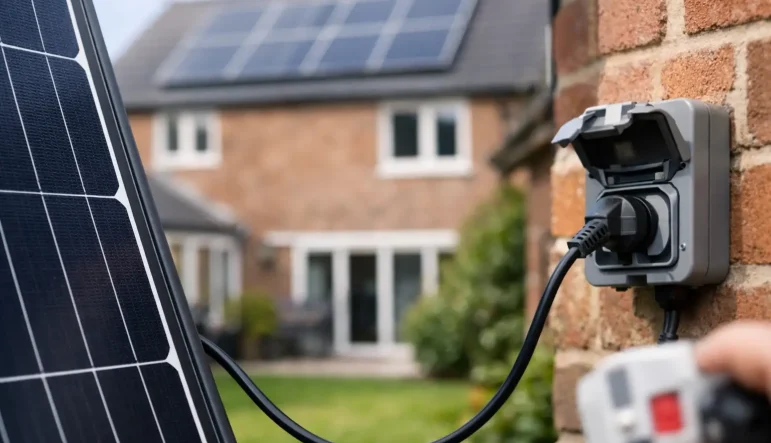
A solar panel that plugs into a household socket sounds like a straightforward way to reduce daytime electricity use. Yet plug-in solar for homes sits at the point where consumer convenience meets electrical safety, network rules and the realities of an existing installation. Before buying a kit, homeowners should establish whether the property, circuit and proposed equipment are suitable.
For many homes, a properly designed fixed solar PV installation remains the clearer and more dependable option. Plug-in equipment may have a place in limited circumstances, but it should not be treated as an appliance that can simply be unpacked and connected without assessment.
Plug-in solar usually describes a small photovoltaic panel or panel set paired with a microinverter. The microinverter converts the panel’s DC output into 230V AC electricity, which is intended to supply power used within the property. These systems are sometimes marketed for balconies, gardens, sheds or renters who cannot install roof-mounted panels.
When a washing machine, router, fridge or other appliance is operating, the solar generation can reduce the amount of electricity drawn from the public network. If generation exceeds demand, power may be exported to the network unless export is controlled. The output from one small panel is modest, so expectations need to be realistic: it can offset a useful share of daytime base load, but it will not provide whole-house power or meaningful generation after dark.
The appeal is understandable. There may be no roof work, scaffolding or large upfront project. However, the connection method is the critical issue. A domestic socket circuit was designed to supply loads connected to it. Introducing generation onto that circuit requires consideration of cable capacity, protective devices, connections and the overall arrangement of the consumer unit.
A plug and socket connection is familiar, but familiarity does not prove suitability for grid-connected generation. The wiring arrangement in a property may be a ring final circuit, a radial circuit, an older installation with limited spare capacity, or part of an altered system with undocumented work. The condition of socket outlets, accessories and connections also matters.
A competent electrical survey should identify the circuit supplying the intended connection point, its protective device, conductor size, condition and other connected loads. It should also establish whether the consumer unit and earthing arrangement are suitable. This is particularly relevant in older homes, converted flats and properties where previous electrical alterations have not been fully documented.
There is also a practical safety question around isolation. A fixed PV installation is normally designed with appropriate isolation, labelling and access for inspection and emergency work. A small plug-in arrangement can make those controls less clear unless it has been planned properly. Emergency responders, electricians and future occupants need to be able to identify that a source of generation is present.
Not every product sold as a plug-in solar kit is appropriate for use in Great Britain. Product claims should be checked carefully, including electrical safety documentation, grid connection certification and compatibility with UK supply arrangements. A CE or UKCA marking alone does not answer every question about whether a particular generation device can be connected to the electricity network.
Solar PV connected to a home does not operate in isolation. It interacts with the local electricity network, which is managed by the distribution network operator, or DNO. This remains true even where the system is small and most electricity is expected to be used on site.
For qualifying small-scale generation, the Engineering Recommendation G98 process is commonly relevant. In many cases, compliant equipment within the applicable limits can be connected and notified to the DNO after commissioning. The exact route depends on the equipment, supply type, generation capacity and any existing generation at the property. A larger arrangement, non-standard equipment or a site with other solar, battery storage or a heat pump may require a different assessment.
The DNO needs accurate information because local network capacity, voltage rise and protection arrangements can affect what is acceptable. A property that already has roof-mounted PV cannot assume that an additional plug-in system is automatically permitted. Total generation must be considered together.
This is not paperwork for paperwork’s sake. Incorrectly connected generation can create problems for network operation and for people working on electrical systems. A competent installer can assess the proposal, confirm the applicable connection process and provide the records that should remain with the property.
A garden panel facing south may produce more energy than one fixed to a shaded balcony, but output is only one part of the decision. Panels need secure mounting that can withstand wind loading and cannot fall, become damaged or create a hazard to people below. A temporary-looking installation can still be subject to severe weather.
On a balcony or external wall, homeowners should consider the building structure, fire safety, cable routes and access for maintenance. In flats, the external fabric, balcony and communal electrical arrangements may belong to the freeholder or management company. Lease terms can restrict alterations, even where no permanent roof work is planned. Tenants will normally need their landlord’s written consent.
Planning permission is not always required for domestic solar, but listed buildings, conservation areas, flats and unusual mounting positions can involve additional controls. A survey should consider the property as a whole rather than focusing only on the available sunshine.
Plug-in solar can be tempting where the budget is limited or the homeowner wants to test solar generation before committing to a larger project. It may be considered for a small, well-sited installation where the equipment is demonstrably suitable, the electrical circuit has been assessed and DNO requirements are properly addressed.
A fixed system is generally more appropriate when the aim is to make a meaningful reduction in electricity purchases, add battery storage, install several panels, export electricity, or improve the long-term value and documentation of the property. It allows the generation system to be designed around the home rather than adapted to the nearest socket outlet.
A properly specified installation can include dedicated circuits, isolation, suitable protective devices, clear labelling and a generation design based on the roof orientation, shading and household demand profile. It also creates a better foundation for future changes, such as an electric vehicle charger, heat pump or battery.
For homeowners considering export payments, installer and equipment requirements may also affect eligibility for a Smart Export Guarantee tariff. Providers set their own tariff terms, so this should be checked before treating export income as part of the financial case.
Before selecting equipment, establish the panel’s rated output, the inverter’s grid connection compliance, the intended mounting method and the circuit that would receive the generation. Check whether the property has existing PV or battery storage, and whether the DNO has already issued conditions for the site.
It is equally useful to consider how electricity is used through the day. A household that is empty from morning until evening may consume little of a small system’s output unless a battery or timed loads are part of the plan. By contrast, a home with daytime occupancy and steady background demand may gain more direct benefit.
The cheapest route is not always the lowest-cost route over time. Replacing unsuitable equipment, correcting non-compliant work or dealing with a damaged external installation can quickly remove the saving promised by an off-the-shelf kit.
The right first step is an electrical and site assessment, not a purchase. This identifies whether plug-in solar is suitable, what connection and notification arrangements are required, and whether a fixed PV design would deliver a safer, more useful result.
SJB Smart Electricals approaches solar-related electrical work as part of the wider installation, with attention to circuit condition, compliance, safe isolation and future demand. A considered survey gives homeowners the information needed to choose a system that works properly with the property, rather than simply adding another device to it.
Considering plug-in solar for homes? Understand UK safety, DNO notific

Citroën has unveiled ë-Berlingo, the latest version of its multi-awa
