York
08:00 AM - 05:00 PM
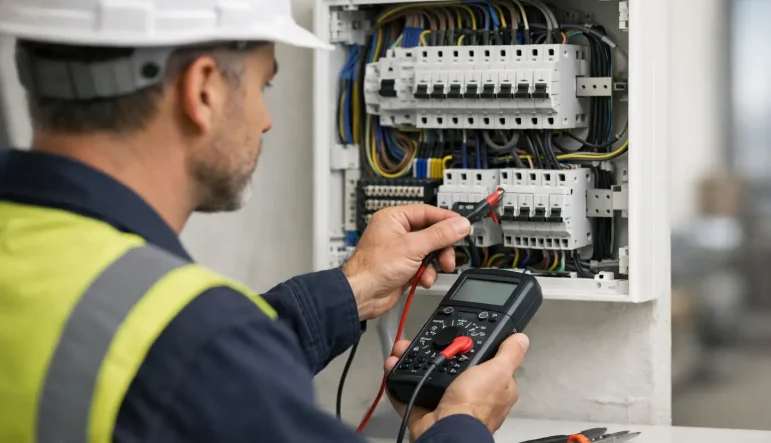
If you are asking what is electrical competency in BS7671, you are usually trying to answer a practical question rather than a theoretical one: who is actually suitable to design, install, inspect or verify electrical work safely and correctly? That question matters on site, in homes, in commercial premises and across higher-risk environments where poor decisions can lead to shock, fire, downtime and failed compliance.
BS 7671 does not reduce competence to a single certificate. It treats competency as something broader and more demanding – a combination of technical knowledge, practical skill, experience, and the ability to recognise the limits of your own capability. That is why two people may both hold qualifications, yet only one may be competent for a specific task.
In practice, electrical competency in BS7671 is about being able to carry out work safely and in accordance with the requirements of the Wiring Regulations. That includes understanding the installation involved, selecting and erecting equipment correctly, inspecting and testing properly, and identifying whether the work is suitable for the environment and intended use.
Competency is not just about knowing the regulations exist. It is about applying them correctly in real conditions. A person may understand cable sizing in a classroom, for example, but still lack the practical judgement needed to assess external influences, installation methods, fault protection, or coordination with existing systems in a live building.
BS 7671 is read alongside wider duties under health and safety law, the Electricity at Work Regulations, and where relevant Building Regulations. So when clients, duty holders and contractors talk about competence, they are usually referring to a standard that reaches beyond passing an exam. They are looking for someone who can complete work safely, verify compliance and make sound decisions when conditions are not straightforward.
The reason is simple. Electrical work varies enormously.
A domestic consumer unit replacement is not the same as modifying a three-phase distribution board in a commercial building. An installation in a clean, dry office is not the same as one in an industrial process area, a transport setting or an outdoor location with increased mechanical risk and environmental exposure. The rules may all sit within the same framework, but the level of judgement needed changes with the task.
That is why competence under BS 7671 is task-specific. Someone may be competent to carry out certain domestic installation work but not competent to inspect a large industrial installation or certify alterations in a specialist environment. Equally, an experienced installer may not automatically be competent in inspection and testing if their knowledge is out of date or they do not routinely carry out verification work.
This point is often missed. Competency is not a badge you earn once and keep forever. It needs to be current, relevant and matched to the work being undertaken.
Anyone involved in electrical work that falls within the scope of BS 7671 needs an appropriate level of competence for their role. That includes those responsible for design, installation, inspection, testing, maintenance and verification.
For clients and property managers, this matters because the person quoting for work is not always the person designing it, installing it or certifying it. On a well-run project, competency is considered across the whole chain. The designer needs to understand protective measures and load characteristics. The installer needs to interpret the design correctly and work safely on site. The inspector or tester needs to assess whether the completed work actually complies.
For homeowners, the principle is the same even if the language used is simpler. If somebody is carrying out electrical work in your property, they should have the knowledge and experience to do that particular job properly, not just general trade experience.
A competent person needs a sound working knowledge of BS 7671 relevant to the work they are doing. That includes protective measures, selection of equipment, earthing and bonding, circuit design, isolation, inspection, testing and certification.
Knowledge on its own is not enough. Practical experience matters because electrical work involves judgement. Installations are rarely perfect textbook examples. Existing systems may be altered over decades, documentation may be incomplete, and site conditions may affect the right course of action.
Competence includes being able to identify unsafe conditions, non-compliances and limitations. It also means knowing when further investigation is required and when a task is beyond your current scope.
This is one of the clearest markers of genuine competence. A competent electrician does not guess. If specialist input, updated training or additional supervision is needed, that is recognised early.
This is where many people ask the wrong question. They ask, “What qualification proves competence?” In reality, qualifications support competence, but they do not automatically prove it in every context.
A current qualification in the Wiring Regulations is useful because it shows the person has studied the latest edition and key changes. Inspection and testing qualifications also matter where certification and verification are involved. Apprenticeship training, NVQs and manufacturer-specific training may all contribute.
But competence is built from a combination of training, supervised experience, current technical understanding and familiarity with the type of installation. Someone can hold several certificates and still be out of their depth in a specialist setting. Just as importantly, a very experienced person can become non-compliant if they have not kept up with changes to the regulations.
For clients, the sensible approach is to look at the overall picture: qualifications, experience, sector background, approval status where relevant, and the ability to explain the work clearly and confidently.
Inspection and testing deserve separate attention because this is where competency is often overstated.
Carrying out dead tests and live tests, interpreting results, identifying departures, and completing certificates correctly require a specific skill set. It is not enough to know how to operate a test instrument. The person must understand what the readings mean, whether they are acceptable for the installation, and what action is required if they are not.
This becomes even more important during periodic inspection, condition reporting and fault finding. Those tasks involve judgement, not just procedure. Poor inspection can leave dangerous defects in service or create false confidence through inaccurate reporting.
For that reason, clients should be cautious about assuming that every installer is automatically competent to perform formal inspection and testing at the required standard.
When competency is missing, problems tend to appear in predictable ways. Circuits are incorrectly selected or overloaded. Protective devices are mismatched. Earthing and bonding are misunderstood. Certification is incomplete or inaccurate. Existing faults are missed. Work passes visually but fails technically.
The cost is not limited to safety risk. In commercial and industrial settings, poor competency can lead to delays, remedial work, failed audits, insurance issues and operational disruption. In domestic properties, it can mean unsafe installations, property damage and reduced trust in the contractor.
By contrast, competent electrical work tends to look organised from the start. Surveys are more accurate. Scope is clearer. Testing is meaningful. Certification supports the actual work completed. That is one reason clients across residential, commercial and infrastructure environments place so much weight on approved, experienced contractors.
The most useful test is whether the contractor can demonstrate relevant capability for the work in question. That means not just general claims, but evidence of suitable training, experience with comparable installations, understanding of the applicable standards, and a professional approach to documentation and verification.
A competent contractor should also ask sensible questions. They should want to understand the building, the load, the environment, the age and condition of the existing installation, and any operational constraints. If the conversation is rushed or oversimplified, that is often a warning sign.
For more complex projects, competency should also include the ability to coordinate survey findings, installation work and workforce knowledge. That joined-up approach is especially valuable where compliance and continuity matter, which is why many clients prefer a provider such as SJB Smart Electricals that operates across assessment, delivery and training.
The simplest way to understand BS 7671 competency is this: it is the proven ability to do a specific electrical task safely, correctly and in line with the regulations.
That means competence is never abstract. It must match the actual job, the actual environment and the actual level of responsibility. If you are appointing someone to carry out electrical work, the right question is not whether they are generally qualified. It is whether they are genuinely competent for this work, on this site, at this time.
That question usually leads to better decisions, safer installations and fewer problems later – which is exactly where good electrical standards should start.
Considering plug-in solar for homes? Understand UK safety, DNO notific

Citroën has unveiled ë-Berlingo, the latest version of its multi-awa
