York
08:00 AM - 05:00 PM
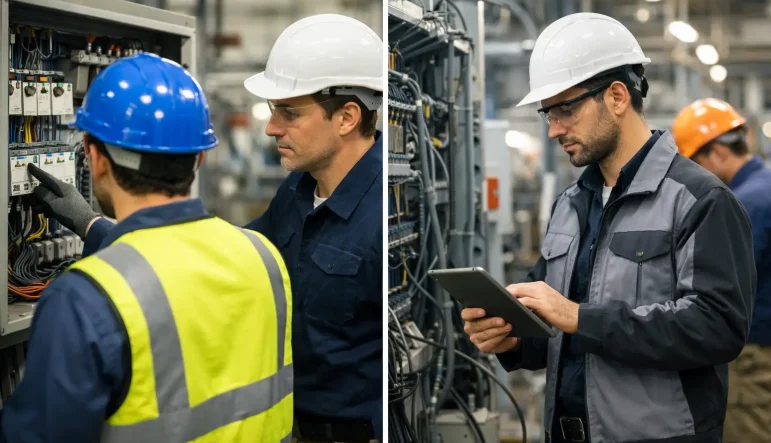
When a line stops, a panel trips, or a compliance gap appears during an inspection, the question is rarely academic. Industrial electrical training vs outsourcing becomes a live operational decision with direct effects on safety, downtime, labour planning, and cost control. For facilities managers, operations leads, and procurement teams, the right answer depends less on theory and more on what your site needs to keep running safely and to standard.
Many businesses start with the hourly rate. That is understandable, but it can lead to the wrong decision. Outsourcing may look more expensive on paper until you factor in the cost of recruiting, supervising, upskilling, certifying, and retaining in-house capability. Training your own team may appear efficient until you consider how long it takes for someone to become genuinely reliable in a live industrial environment.
The opposite can also be true. Relying fully on external contractors for every fault, upgrade, isolation procedure, or planned maintenance activity can create delays and reduce internal resilience. If your team cannot handle first-line electrical issues safely, even minor problems can escalate into lost production time.
In practice, most sites are weighing control against flexibility. Training builds internal knowledge and faster day-to-day response. Outsourcing provides specialist expertise, independent assurance, and access to approved professionals without carrying the full overhead of an in-house department.
Training is about more than sending staff on a course. In an industrial setting, meaningful electrical training strengthens judgement, hazard awareness, safe systems of work, and task competence. It helps teams understand not only what to do, but when not to proceed.
That distinction matters. A well-trained in-house team can identify deterioration early, report defects accurately, and carry out routine electrical responsibilities within the limits of their competence. This improves response times and supports better communication between operations and specialist contractors.
There is also a continuity benefit. Your own people know the site, the production schedule, the access constraints, and the recurring faults that may never appear in a handover note. That site familiarity can be valuable in manufacturing plants, logistics facilities, depots, and transport environments where downtime windows are narrow and electrical systems interact with wider operational risks.
Training also supports a stronger safety culture. When supervisors and operatives understand isolation principles, inspection requirements, and signs of electrical stress, the whole site tends to make better decisions. Problems are spotted earlier. Unsafe improvisation becomes less likely. Escalation routes become clearer.
Still, training has limits. It does not instantly turn a maintenance operative into a fully competent industrial electrician. Nor does it remove the need for proper authorisation, supervision, or external certification where required. If the training scope is poorly defined, businesses can develop false confidence, which is often more dangerous than a known skills gap.
Outsourcing gives you access to experience that is already proven in the field. That can be the difference between a fast, compliant resolution and a long disruption caused by trial and error. In regulated or high-risk environments, bringing in an approved electrical contractor is often the safer and more commercially sensible route.
External specialists can support surveys, installations, testing, fault finding, upgrades, shutdown work, and targeted remedial actions. They also bring broader exposure to different systems and failure patterns across sectors. That outside perspective is useful when internal teams have become used to workarounds or have limited experience of newer standards and technologies.
Another advantage is scalability. Workloads in industrial environments are rarely flat. You may need very little support one month and intensive support during a plant modification, expansion, or compliance programme. Outsourcing allows you to match labour and technical capability to the job without carrying permanent payroll cost for occasional needs.
There is a governance benefit as well. Independent specialists can provide clearer documentation, traceability, and confidence for insurers, auditors, and duty holders. For many organisations, particularly those with multiple sites or infrastructure responsibilities, that accountability matters as much as the technical work itself.
The trade-off is dependency. If your internal team has little electrical understanding, every issue has to wait for external attendance, and that can affect response times. Outsourcing also works best when the contractor understands your site properly. Without good communication and planning, even highly capable specialists can lose time on inductions, access restrictions, and incomplete asset information.
If your environment carries higher risk, compliance should lead the discussion. Industrial electrical systems involve hazards that cannot be managed by goodwill or general maintenance experience alone. Where inspection, testing, installation, or fault rectification falls outside your team’s proven competence, outsourcing is usually the stronger option.
Training still plays an important role here. It equips managers and operatives to recognise risk, follow procedures, and work effectively with specialists. But compliance-sensitive work should be aligned with the right level of technical authority and approval.
If your site suffers frequent minor electrical issues, internal training can improve first response and reduce disruption. A team that knows how to identify, isolate, report, and support recovery safely can save valuable time.
If the issues are less frequent but more complex, outsourcing is often more efficient. There is little value in maintaining a high-cost in-house capability for specialist tasks that arise only occasionally.
Short-term and long-term costs are not the same. Outsourcing can reduce overheads, especially where demand is variable. Training can deliver strong value if your site has repeat needs and enough work to justify developing internal capability.
A realistic cost review should include wages, course fees, supervision time, lost productivity during training, tools, testing equipment, certification needs, and the cost of mistakes. On the outsourcing side, include call-out structure, planned maintenance rates, project pricing, and the operational impact of waiting for attendance.
A simple facility with limited electrical complexity may only need trained internal awareness and periodic specialist support. A large industrial plant with automation interfaces, distribution upgrades, shutdown planning, and strict permit systems is different. The more complex the environment, the more valuable specialist outsourced capability becomes.
Training is often the right investment when you already have a stable maintenance team, recurring low-to-medium complexity tasks, and a clear boundary around what staff are expected to handle. It also suits organisations that want better site ownership and stronger day-to-day operational resilience.
The strongest results come when training is tied to real responsibilities. That means defining which tasks can be handled internally, which must be escalated, and how competence will be reviewed over time. Training without those controls becomes a box-ticking exercise.
Outsourcing is usually the better route when work is technically complex, infrequent, safety-critical, or heavily regulated. It also makes sense where recruitment is difficult, where downtime is expensive, or where independent verification carries weight with clients, insurers, or auditors.
For many organisations, outsourcing removes the burden of trying to build a capability they do not need every day. It allows them to focus internal resource on operations while using approved specialists for higher-risk electrical work.
For many businesses, the best answer in industrial electrical training vs outsourcing is not one or the other. It is a controlled blend of both. Internal teams receive practical training to improve awareness, safe response, and coordination. External electrical specialists handle advanced diagnostics, installation, inspection, testing, and work requiring formal approval or deeper technical experience.
This hybrid model gives you resilience without overextending your internal team. It also improves contractor performance because your people can provide better fault information, site access planning, and operational context. The relationship becomes more effective on both sides.
That is where a full-service provider can be especially useful. A contractor that understands surveys, installation, and training can help shape the boundary properly rather than pushing every issue towards one solution. For organisations that need capability development as well as dependable delivery, that joined-up approach is often more practical than dealing with separate providers.
The right decision starts with an honest look at your site. Consider the technical level of your systems, the competence of your current team, your compliance exposure, and how much disruption a delayed response would cause. If training improves safe everyday capability, invest in it. If specialist work sits beyond your internal limits, outsource it with confidence. The strongest operations know the difference.

Understand Part P electrical safety rules for homes in England and Wal

Citroën has unveiled ë-Berlingo, the latest version of its multi-awa
