York
08:00 AM - 05:00 PM

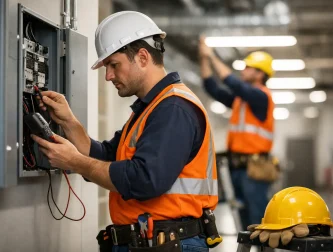
When a production line stops, a tenant reports repeated power faults, or a transport facility faces an avoidable outage, the issue is rarely just equipment. In many cases, it comes back to competence on site. Electrical training for maintenance teams gives staff the judgement to work safely, identify faults earlier, and know when a task is within scope and when it needs a qualified electrical contractor.
For facilities managers, operations leads and property decision-makers, that matters for more than safety alone. It affects uptime, compliance, contractor coordination and the quality of day-to-day maintenance decisions. Teams do not need to become fully qualified electricians to add value, but they do need the right level of knowledge for the environments they support.
Maintenance teams sit close to the practical realities of a building or site. They are often first to respond when circuits trip, lighting fails, machinery behaves unpredictably or a distribution area shows signs of heat stress or damage. Without proper training, those first responses can create risk. With the right training, they become more controlled, more informed and more useful.
The strongest training programmes reduce guesswork. Staff learn to recognise common warning signs, isolate equipment correctly where authorised, record findings clearly and escalate concerns before a minor defect becomes a serious incident. That is especially important in commercial and industrial settings where electrical systems support business continuity, critical assets and public safety.
There is also a compliance dimension. Employers have duties around safe systems of work, competence and risk management. Training helps demonstrate that maintenance personnel have been instructed appropriately for the tasks they are expected to perform. It does not remove the need for formal qualifications where regulations require them, but it does strengthen the overall safety position of the organisation.
Not every site needs the same depth of training. A residential block, a warehouse, a food production plant and a rail-adjacent facility all carry different risks. Even so, useful electrical training for maintenance teams usually starts with the same foundations.
Teams should understand basic electrical principles well enough to interpret what they are seeing in practice. That includes current, voltage, load, protective devices, earthing, isolation and the purpose of key components in an installation. The goal is not theory for its own sake. It is to help people make safer, more accurate decisions when faults appear.
Training should also cover safe isolation procedures at a level appropriate to the role. This is an area where many businesses benefit from clearer boundaries. Some maintenance staff may only need awareness training so they can identify hazards and support permit systems. Others may need practical instruction in isolation for specific equipment under controlled procedures. The difference matters.
Fault recognition is another core area. Burn marks, nuisance tripping, unusual odours, damaged containment, overloaded circuits and signs of water ingress should all trigger the right response. Good training helps staff distinguish between a housekeeping issue, a maintenance issue and a situation that requires immediate intervention by an authorised electrical professional.
Documentation is often overlooked, but it should not be. Maintenance teams need to understand how to record defects, inspection findings and temporary controls in a way that supports compliance and follow-on work. Poor records create confusion, repeated site visits and unnecessary downtime.
A common mistake is to buy a standard course and assume it will suit every building. In practice, the value of training depends on how closely it reflects the site’s systems, risks and working patterns.
In a commercial office environment, the emphasis may be on landlord services, emergency lighting, distribution boards, plant rooms and safe coordination with tenants or contractors. In industrial settings, training often needs a stronger focus on machinery, motor control, isolation procedures, environmental conditions and planned maintenance routines. Infrastructure sites can demand another level of discipline again, particularly where access control, public interface or operational continuity is involved.
This is where a contractor with broad sector experience can add more than classroom delivery. Training is stronger when it is informed by actual site conditions, existing installations and the practical limits of the maintenance function. SJB Smart Electricals works across domestic, commercial, industrial and transport-related environments, so training can be aligned with the operational realities clients face rather than delivered as a detached theory exercise.
One of the most important judgements in any training plan is deciding what staff should understand, what they should do, and what they should never attempt. That balance protects both people and the organisation.
Awareness training is useful where maintenance teams need to identify electrical risks, support safe access, report defects and coordinate effectively with approved contractors. It raises standards without encouraging overreach. For many property managers and general facilities teams, that may be the right level.
Hands-on competence training has a place too, but only where the role genuinely requires it and the employer can support it with the correct procedures, supervision and limits of authority. If a team is expected to isolate plant, replace selected components or carry out routine electrical checks, training needs to be more specific and documented more carefully.
The trade-off is straightforward. Broader practical capability can improve response times and reduce minor disruption, but only if it is properly managed. If not, it can blur responsibilities and increase risk. The right approach depends on the complexity of the site, the experience of the team and the controls already in place.
Electrical safety tends to dominate the conversation, rightly so, but operational performance should not be ignored. A trained maintenance team can often spot deterioration before it causes failure. They notice patterns, ask better questions and provide more useful information to electrical specialists.
That has a direct effect on downtime. Instead of reporting that a system has failed, trained staff are more likely to report the sequence of events, the affected circuits, the visible condition of equipment and any temporary measures already taken. That shortens diagnosis time and improves the quality of remedial work.
Training also supports planned maintenance. Teams become more consistent in inspections, more disciplined in reporting and better able to prioritise issues based on risk rather than convenience. Across a large estate or busy site, those gains add up.
The best training providers do more than present slides and issue certificates. They understand how electrical systems behave in live environments and how maintenance teams actually work. That practical grounding is essential.
Look for a provider with proven technical experience, relevant approvals and a clear understanding of compliance requirements. Ask whether the training can be adapted to your sector, your assets and the level of responsibility your team holds. A credible provider should be comfortable discussing boundaries, not just capabilities.
It is also worth asking how the training connects to wider electrical services. If your business needs surveys, remedial works, installation upgrades and workforce training, there is value in dealing with a provider that can see the full picture. That creates better consistency between what your team is taught and what your site actually requires.
Training only works if it changes behaviour on site. That means managers need to reinforce it through procedures, supervision and regular review. If the course says one thing but day-to-day practice says another, the training value drops quickly.
Refresher sessions are often worthwhile, particularly in higher-risk environments or where teams change frequently. Toolbox talks, updated isolation procedures and periodic competence checks can help keep standards current. It is also sensible to review training after significant changes to plant, layout or electrical infrastructure.
A good sign that training is working is not just fewer incidents. It is clearer reporting, better contractor handovers, more confident decision-making and fewer avoidable mistakes around electrical systems. Those are practical outcomes, and they matter.
For organisations responsible for people, property and operational continuity, electrical training should not be treated as a box-ticking exercise. It is part of building a maintenance function that knows its responsibilities, respects its limits and contributes positively to safe, reliable operations. Start with the real risks on your site, train to those conditions, and set expectations that your team can follow with confidence.
Commercial electrician services for compliant, efficient premises, fro

Citroën has unveiled ë-Berlingo, the latest version of its multi-awa
