York
08:00 AM - 05:00 PM
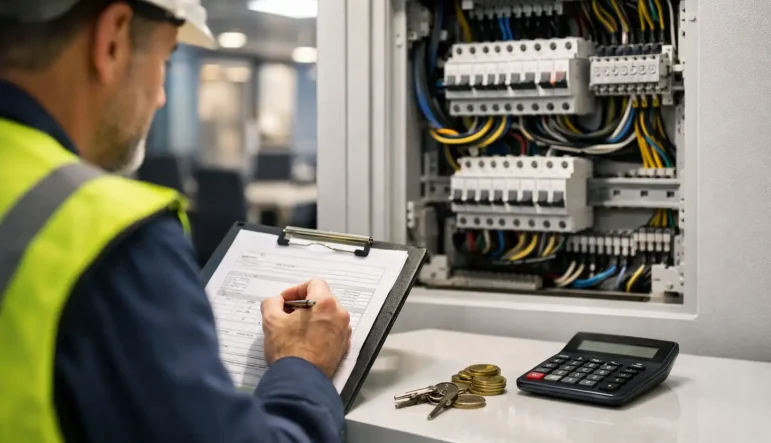
If you are budgeting for compliance across a shop, office, warehouse or mixed-use site, commercial EICR certificate cost is rarely a flat figure. Two premises with similar floor area can price very differently once circuit numbers, operating hours, access restrictions and the condition of the installation are taken into account. That is why quick headline prices often create more confusion than clarity.
For most commercial clients, the real question is not simply what an EICR costs, but what is actually being tested, how much disruption the inspection will cause, and whether the result will stand up to scrutiny from insurers, landlords, tenants and safety auditors. A proper EICR is a technical assessment of the fixed electrical installation, not a box-ticking exercise.
The biggest pricing factor is usually the number of circuits. A small office unit with a modest distribution board and limited power demand will generally take far less time to inspect and test than a retail premises, workshop or industrial unit with multiple boards, three-phase supplies and a wider spread of equipment connections. More circuits mean more testing, more documentation and more time on site.
Property type matters as well. An open-plan office is usually simpler than a restaurant, care setting, school or manufacturing environment. Premises with specialist plant, outbuildings, external supplies, emergency systems interfaces or restricted areas need a more considered inspection plan. If parts of the installation can only be accessed outside trading hours, that can increase cost too.
The age and condition of the installation also have a direct impact. Older systems often require more detailed investigation because labelling may be poor, previous alterations may not be clearly recorded, and components may show wear or signs of non-compliant work. Where an installation has been extended several times over the years, testing can take longer simply because the layout is less straightforward.
Another factor is how the site operates. A vacant unit is generally easier to test than a busy business with staff, customers, stock movement and live operational constraints. If the work must be completed at night, in phases, or around critical services, the cost can rise because the contractor has to plan for controlled access and reduced disruption.
There is no single national rate that applies to every property, but broad guide prices can still be useful. A very small commercial premises with a limited number of circuits may start from a few hundred pounds. Mid-sized offices, retail units and light commercial spaces often fall into a higher band, while larger premises with multiple boards or three-phase installations can move well beyond that.
In practical terms, many commercial inspections are priced after a review of the installation details rather than from square footage alone. Floor area gives some indication of scale, but it does not tell you how electrically complex the premises are. A compact workshop can be more involved than a larger but simpler office suite.
Where clients ask for a like-for-like comparison between quotes, it is worth checking whether the contractor has priced for the same scope. One quote may cover a full inspection and test of all accessible circuits with a formal report, while another may be based on limited assumptions that change once site conditions are confirmed.
A low figure can be genuine if the premises are small, modern and easy to access. Equally, it can mean the inspection has been priced too lightly. When that happens, one of two things usually follows. Either the contractor rushes the work, or additional charges appear once the job starts.
That is not a minor issue. If testing is cut short, the resulting report may not reflect the actual condition of the installation. For property managers and duty holders, that creates a false sense of security and can lead to further cost later when defects are discovered during maintenance, tenancy changes or insurance reviews.
A sound quote should reflect the time needed to inspect, test, document findings and issue the report properly. It should also make clear whether any remedial works are included or excluded. In most cases, the EICR itself covers inspection and reporting only. Repairs are usually quoted separately once observations have been classified.
When reviewing commercial EICR certificate cost, it helps to look beyond the total and ask what the service includes. A competent provider should account for the inspection of the fixed wiring installation, testing of circuits, assessment against the current wiring regulations, and preparation of the completed report with coded observations where necessary.
You should also expect clarity around attendance arrangements, access requirements and any assumptions about downtime. If the site needs isolation of certain circuits, that should be discussed in advance. If there are business-critical areas that cannot be interrupted, the contractor should explain how those constraints affect scope, timing and cost.
For more complex environments, the value is often in planning as much as testing. Industrial sites, transport-linked facilities and operational commercial estates may need phased attendance, liaison with facilities teams and coordination with health and safety controls. That is where an experienced electrical contractor adds practical value rather than just issuing paperwork.
Yes, and this is where many budgets shift. The certificate cost and the total compliance cost are not always the same thing. If the inspection identifies damaged accessories, inadequate earthing, overloaded circuits, missing bonding, outdated protective devices or signs of poor previous alterations, remedial works may be required before the installation can be considered satisfactory.
Some reports come back satisfactory with only minor advisory notes. Others identify C1, C2 or FI observations that need urgent action or further investigation. The extent of that follow-on work depends on the condition of the installation, not the original inspection price. That is another reason the cheapest EICR is not always the cheapest route overall.
For clients managing older property portfolios, it is often sensible to treat the EICR as both a compliance requirement and a planning tool. A detailed report can help prioritise upgrades, phase expenditure and reduce the chance of reactive electrical faults causing disruption later.
Commercial premises are commonly inspected at intervals that reflect the building type, its use and the risk profile of the installation. Many businesses work to a five-year cycle, but some environments need more frequent inspection. Sites exposed to moisture, heavy use, public access or harsher operating conditions may justify shorter intervals.
Lease terms, insurance requirements and internal health and safety policies can also influence timing. If there has been a change of occupancy, significant alteration works, visible deterioration or a history of electrical faults, an earlier inspection may be appropriate even if the previous report has not yet expired.
A reliable contractor will not treat interval guidance as one-size-fits-all. The right frequency depends on the premises and how they are used.
The quickest way to get a realistic quote is to provide useful site information from the outset. The property address alone is rarely enough. If possible, share the type of premises, approximate number of distribution boards, whether the supply is single-phase or three-phase, any known access restrictions, and whether the site must remain operational during testing.
Photos of boards, existing certificates or previous EICRs can help too, especially for larger sites. That gives the contractor a better basis for estimating labour, attendance time and reporting scope. It also reduces the risk of later variation.
For businesses operating across multiple premises, consistency matters. A provider with experience across commercial, industrial and regulated settings is better placed to standardise reporting quality and attendance planning. That matters just as much as the initial price when you are responsible for estates, compliance records or procurement oversight.
Commercial electrical inspection is one of those services where competence shows up in the detail. Clear documentation, realistic planning, thorough testing and well-judged observations are what make the report useful. That is particularly relevant where safety responsibilities sit with landlords, managing agents, facilities teams or business owners who need reliable evidence of due diligence.
An approved and experienced contractor should be able to explain not only the cost, but the reasoning behind it. At SJB Smart Electricals, that practical, standards-led approach is what clients expect from an electrical partner working across varied environments.
If you are comparing quotes, ask which one gives you confidence that the installation has been properly assessed, the report will be technically sound, and the next steps will be clear. That is usually where the real value sits, long after the cheapest number has been forgotten.
Commercial electrician services for compliant, efficient premises, fro

Citroën has unveiled ë-Berlingo, the latest version of its multi-awa
