York
08:00 AM - 05:00 PM
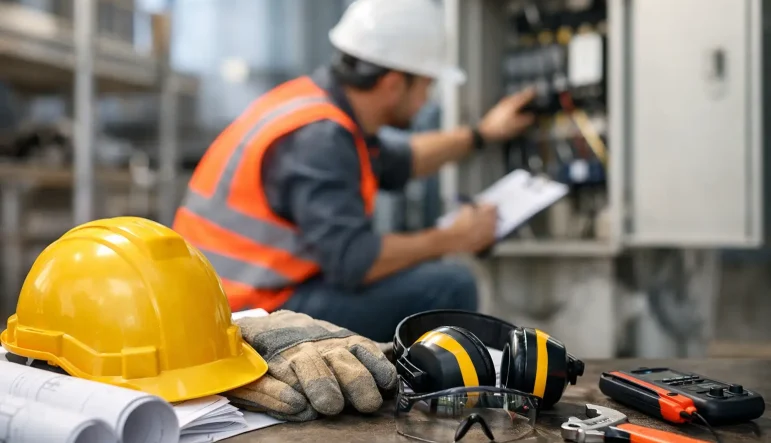
A job can look straightforward until the cover comes off, the readings do not match the drawings, or the supply you expected is not the supply on site. That is why the best safety checks before installation are never an administrative extra. They are what prevent damaged equipment, failed inspections, avoidable downtime and, most importantly, risk to people.
For homeowners, that may mean confirming an older consumer unit is suitable before adding new circuits. For facilities teams, it may mean identifying load constraints, isolation arrangements or access risks before a contractor starts work. In industrial and transport settings, the same principle applies at a higher level of consequence. If the checks are weak, the installation inherits that weakness.
Electrical installation work is not only about fitting equipment correctly. It starts with understanding the condition of the existing system, the environment it sits in and the duties that apply to the site. A compliant design can still fail in practice if the supply characteristics are wrong, the protective measures are unsuitable, or the working area introduces risks that were not accounted for.
This is where many delays and safety issues begin. A specification may be sound on paper, but the site may tell a different story. Cable routes may be obstructed, earthing arrangements may be unclear, previous alterations may not be documented, and isolation points may not be where they were expected to be. Good pre-installation checks close that gap between assumption and reality.
Before any new work is planned, the existing electrical installation needs to be understood properly. That includes the age and type of distribution equipment, the condition of boards and protective devices, visible signs of deterioration, and whether earlier modifications appear competent. In many properties, especially older commercial premises and domestic refurbishments, there is often a mixture of original and later additions. That does not always mean the system is unsafe, but it does mean assumptions are risky.
An initial survey should establish whether the existing installation can safely support the proposed work. If a board is already fully loaded, if there is heat damage around terminations, or if there are signs of poor previous workmanship, installation should not proceed as though the new addition exists in isolation. The new work must be compatible with the old system, not simply attached to it.
A board may appear tidy and still present underlying faults. Likewise, older equipment is not automatically unsuitable if testing confirms it remains serviceable and appropriate. Verification should therefore include suitable inspection and testing, not visual judgement alone. Continuity, insulation resistance, polarity, earth fault loop impedance and other relevant test results help establish whether the installation is sound enough to extend or alter.
One of the most basic checks is also one of the most critical. Before installation begins, there must be a clear method for safe isolation. That means identifying the correct point of isolation, confirming that isolation can be achieved without ambiguity, and ensuring it can be secured against inadvertent re-energisation while work is carried out.
In domestic settings this may be relatively simple, although even there mislabelled circuits are common. In commercial and industrial environments, isolation can be more complex, particularly where there are multiple supplies, standby systems, photovoltaic inputs or interconnected equipment. Assuming a circuit is dead because one switch has been operated is not a safe system of work.
Where operations cannot tolerate a full shutdown, the planning becomes more detailed. Partial isolation may be possible, but only if the circuits affected are fully identified and the residual risk is controlled. If that cannot be achieved, the installation programme needs to reflect that reality rather than forcing unsafe workarounds.
Earthing and bonding are central to electrical safety, yet they are often taken for granted until a survey proves otherwise. Before new equipment is installed, the earthing arrangement must be identified and verified. Main protective bonding should be checked, and the proposed work assessed against the fault protection measures already in place.
This matters because new loads, new circuits and new distribution points can alter the demand placed on the protective system. If the earthing arrangement is inadequate, or if disconnection times cannot be met, the installation may not provide the level of protection intended by the design. In practice, this is one of the clearest examples of why installation should follow proper assessment rather than assumption.
There are also site-specific considerations. External installations, industrial areas and infrastructure sites may present additional concerns around exposed conductive parts, environmental conditions or imported earths. What is suitable in a domestic property may not be suitable in a workshop, depot or public-facing transport environment.
A common reason for post-installation faults is that the existing system was never properly assessed for the added demand. The incoming supply, the distribution board, the cable routes and the protective devices all need to be checked for capacity and suitability.
That does not only mean asking whether there is physical space for another protective device. It means considering whether the installation can safely carry the additional load under realistic operating conditions. Diversity may be relevant in some projects, but it should not be used loosely to justify marginal capacity. A cautious assessment is usually the better route, especially where future expansion is likely.
Voltage drop, thermal constraints and discrimination between protective devices may also need attention. In larger commercial and industrial work, these are not secondary details. They affect reliability, operational continuity and compliance. A system that technically functions but trips unnecessarily under normal use is not a successful outcome.
Electrical safety is shaped by the environment as much as by the circuit design. Before installation, the working area and the final operating environment should be assessed for conditions that affect selection, protection and safe access.
Moisture, dust, heat, vibration, chemical exposure and mechanical damage can all change what equipment is suitable. The route for containment and cabling may also introduce risks if it passes through congested voids, plant areas or public access zones. In some settings, the issue is less about fitting the equipment and more about whether it can be maintained and inspected safely afterwards.
Access checks are equally important. If working at height, in confined areas or near live services is likely, that needs to be known before the job starts. The right control measures, equipment and sequencing can then be planned properly. Turning up and trying to resolve these constraints on the day is where standards tend to slip.
The best safety checks before installation always include documentation. Existing records, previous certificates, circuit schedules and drawings should be reviewed where available. If those documents are missing or clearly unreliable, that should be treated as a project risk, not brushed aside.
Accurate information supports safe isolation, correct design and efficient fault finding later on. Poor labelling and incomplete records create unnecessary exposure for whoever uses, manages or maintains the installation after the works are complete. For commercial clients and duty holders, this is also a governance issue. Compliance is not only about the finished installation but about whether the work can be evidenced and understood.
Depending on the project, additional duties may apply under site rules, permit systems, fire strategy requirements or sector-specific standards. Healthcare, industrial processing, transport infrastructure and multi-occupancy buildings can each introduce their own compliance considerations. That is why experienced contractors do not treat every installation as interchangeable.
A useful safety process is not limited to test instruments and paperwork. It also includes a proper pre-start discussion with the client, site contact or responsible person. This is often where practical issues emerge – restricted working hours, hidden services, operational shutdown windows, vulnerable occupants, or concerns about business continuity.
For domestic clients, the conversation may focus on disruption, access and the condition of older wiring. For business and infrastructure clients, it may involve permits, phasing, temporary supplies or coordination with other contractors. These details affect how safely the work can be delivered. If they are not understood early, the installation team is left managing preventable uncertainty.
A dependable contractor will ask direct questions at this stage and challenge unclear information where needed. That is not overcaution. It is part of responsible delivery.
Not every project should proceed immediately. If the survey identifies inadequate earthing, overloaded boards, signs of damage, undocumented alterations or uncertain isolation arrangements, the safer course may be to pause and correct the underlying issue first. That can feel inconvenient, especially when timelines are tight, but it is usually cheaper and safer than forcing an installation into a system that is not ready for it.
This is particularly true where regulated environments or high-occupancy premises are involved. A rushed job may pass the immediate programme pressure on to the next stage, but it rarely removes the risk. In many cases, it simply hides it until energisation, inspection or failure.
SJB Smart Electricals works across domestic, commercial, industrial and transport-facing environments, and the same principle holds across them all: a sound installation starts before the first fixing begins. If the checks are thorough, the work that follows stands on solid ground.
The practical test is simple. Before any installation starts, ask whether the existing system, the site conditions and the method of work are genuinely understood. If the answer is uncertain, that is the next job to do.
Commercial electrician services for compliant, efficient premises, fro

Citroën has unveiled ë-Berlingo, the latest version of its multi-awa
