York
08:00 AM - 05:00 PM
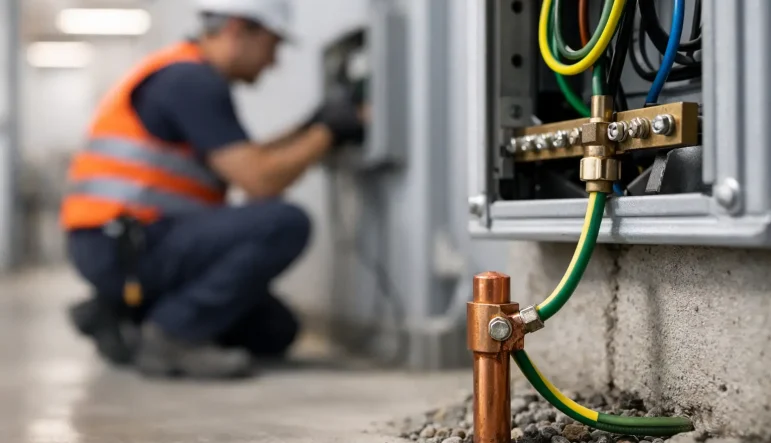
A circuit can look perfectly normal right up to the moment a fault makes exposed metal live. That is why earthing is important in electrical safety. It gives dangerous fault current a controlled path to earth, helping protective devices operate quickly and reducing the risk of electric shock, equipment damage and fire.
For homeowners, that may mean a cooker, consumer unit or EV charger staying safe under fault conditions. For commercial sites, industrial facilities and transport environments, it is part of a wider safety system that supports compliance, continuity and safe maintenance. Earthing is not an optional extra. It is a fundamental part of how electrical installations are designed to fail safely.
Earthing connects conductive parts of an installation to the general mass of earth. Under normal operation, that connection does not carry current in the way a live or neutral conductor does. Its purpose becomes critical when something goes wrong.
If insulation fails or a live conductor touches a metal enclosure, the metalwork can become energised. Without a proper earth path, that exposed part may sit at a dangerous voltage. A person touching it could become the easiest route for current to flow, with potentially severe consequences.
With effective earthing in place, fault current is directed away through a low resistance path. That higher fault current should then cause a fuse, circuit-breaker or residual current device to disconnect the supply fast enough to limit harm. In simple terms, earthing helps turn a hidden fault into a fault that protection can detect and clear.
The clearest reason why earthing is important in electrical safety is personal protection. Electric shock risk rises sharply when accessible metal parts are not kept close to earth potential during a fault.
Take a washing machine, distribution board or metal light fitting. If a fault makes the casing live and there is no reliable earthing, anyone who touches it while in contact with earth or other conductive surfaces may complete the circuit. The severity of shock depends on several factors, including voltage, body resistance, contact time and the path through the body. That means outcomes vary, but relying on luck is never a safety strategy.
Earthing works alongside automatic disconnection of supply. When fault current flows effectively to earth, protective devices are more likely to trip within the required time. That is the difference between a brief fault event and a prolonged dangerous condition.
There is a practical point here. Earthing on its own does not guarantee total protection in every scenario. If the earth path is poor, damaged or incorrectly installed, the current may be too low to operate the protective device quickly enough. That is why design, verification and periodic inspection matter just as much as the presence of an earth conductor on paper.
Shock protection gets most of the attention, but fire prevention is just as important. Electrical faults generate heat. Where fault current travels through unintended paths, loose connections or damaged components, temperatures can rise enough to ignite surrounding materials.
A correctly earthed system helps faults clear quickly, limiting sustained heating and arcing. In commercial and industrial settings, this is especially significant because fault energy can be higher and downtime more costly. A fault left unresolved can damage switchgear, control panels, motors, IT equipment and production assets, not just the final circuit where the problem began.
In older buildings, the fire risk can be more complicated. You may find ageing wiring, altered circuits, mixed earthing arrangements or legacy equipment that no longer suits the current load profile. In those situations, earthing must be assessed as part of the whole installation, not treated as a single isolated checkbox.
People often use earthing and bonding as if they mean exactly the same thing. They are closely related, but they do different jobs.
Earthing provides the path for fault current to ground. Bonding connects conductive parts, such as pipework or structural metalwork, so they remain at substantially the same potential and do not create dangerous voltage differences. Both are essential, and both support protective devices in doing their job.
This distinction matters during surveys and remedial work. An installation can have an earth connection but still be unsafe if bonding is missing, undersized or incorrectly terminated. Equally, modern protective devices such as RCDs improve safety significantly, but they do not replace the need for proper earthing and bonding. Good electrical safety comes from layers of protection working together.
The principle is consistent, but the practical demands vary by site.
In domestic properties, earthing protects people using everyday appliances and fixed installations. The risks often increase during renovations, consumer unit upgrades, garden building supplies or the addition of high-load equipment such as heat pumps and EV charging points. Changes like these can expose shortcomings in existing earthing arrangements.
In commercial premises, earthing supports both occupant safety and business continuity. Offices, shops, schools and public buildings typically include a wide range of circuits, from lighting and small power to alarms, HVAC systems and data infrastructure. A fault in one part of the installation can have wider consequences if the protective measures are not coordinated.
Industrial sites usually present harsher conditions. Moisture, vibration, dust, metalwork and higher fault levels all place greater demands on the electrical system. Here, earthing is part of controlling risk around machinery, control systems and plant operation. The cost of getting it wrong is measured not only in safety terms, but also in lost production and damaged assets.
In infrastructure and transport settings, earthing takes on another layer of significance because installations often serve critical operations and large numbers of people. Compliance, reliability and safe isolation procedures are central, and any weakness in earthing can undermine the wider safety case.
When earthing problems are found, the issue is not always that earth is completely absent. More often, the danger comes from defects that reduce its effectiveness.
That may include high earth loop impedance, loose or corroded connections, damaged protective conductors, poor workmanship during alterations, or incorrect assumptions about the earthing arrangement supplied to the premises. On older installations, labels may be missing or inaccurate, and previous modifications may not have been tested thoroughly.
There is also the problem of visible versus actual safety. A socket, metal enclosure or circuit may appear properly installed while hiding a serious fault path issue behind the accessory or at the origin of the supply. This is why competent testing is essential. Visual checks help, but they are not enough on their own.
If you want to know whether earthing is doing its job, the answer comes from inspection and measured results, not assumptions. Electrical testing verifies continuity, impedance and the ability of protective devices to disconnect within required times.
For homeowners, an Electrical Installation Condition Report can identify whether the installation remains satisfactory for continued use and whether remedial work is needed. For commercial and industrial duty holders, periodic inspection forms part of managing legal responsibilities, insurance expectations and maintenance planning.
Testing is particularly important after alterations, tenancy changes, equipment upgrades or reports of nuisance tripping, shocks or overheating. These signs do not always point directly to an earthing fault, but they do justify a proper assessment.
For organisations operating across multiple building types, working with an approved contractor simplifies this process. Firms such as SJB Smart Electricals support clients not only with installation, but with surveys and training that help teams understand risk, compliance and safe operation in practice.
British electrical standards set clear expectations around earthing, bonding and protective measures. Compliance is essential, but a box-ticking approach is not enough. An installation has to perform safely under real fault conditions, in the actual environment where people use it.
That is where experience makes a difference. A technically compliant design on paper may still need practical consideration around load growth, environmental exposure, maintenance access or future expansion. Earthing should be reviewed as part of the broader operational picture, especially in sites that have evolved over time.
The most reliable approach is straightforward. Treat earthing as a core safety control, verify it properly, and reassess it whenever the installation changes. Electrical systems do not need to fail often to be dangerous. One fault is enough, and when that fault happens, the quality of the earthing arrangement can determine whether the outcome is a routine disconnection or a serious incident.
If there is any doubt about the condition of an installation, the sensible step is to have it inspected by a competent electrician. Good earthing is mostly invisible when everything is working well, but that quiet reliability is exactly what makes it so valuable.

Learn how to choose electrical survey provider expertise for safe, com

Citroën has unveiled ë-Berlingo, the latest version of its multi-awa
