York
08:00 AM - 05:00 PM
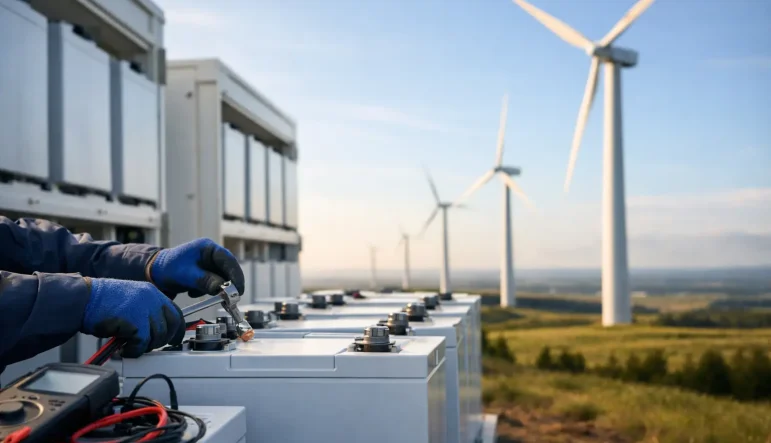
When a wind system underperforms, the turbine is not always the first place to look. In many cases, battery maintenance and wind energy installations are linked far more closely than site owners expect. A well-specified battery system can steady supply, protect stored energy and support continuity. A poorly maintained one can shorten asset life, reduce performance and create avoidable safety risk.
That matters whether the installation serves a rural property, a commercial site with resilience requirements, or a transport or infrastructure environment where downtime carries wider operational consequences. Wind generation is only one part of the system. Storage, monitoring, protection and maintenance practice all shape the result.
Wind output is variable by nature. Some sites generate strongly overnight or during low-demand periods, while others see inconsistent production over the week. Batteries help bridge that variation by storing surplus energy and releasing it when demand rises or generation falls. That sounds straightforward, but battery systems work hard in this role, and their condition has a direct effect on reliability.
As batteries age, their ability to hold charge declines. Internal resistance can increase, charge acceptance can fall, and temperature sensitivity may become more pronounced. In a wind installation, those changes can create a chain reaction. Storage capacity drops, usable output narrows, charging cycles become less efficient and operators may rely more heavily on backup power or grid support.
There is also a compliance and safety dimension. Battery systems involve live electrical equipment, protective devices, ventilation considerations, fire risk controls and manufacturer-specific maintenance requirements. In regulated or high-demand settings, informal inspection is not enough. The system needs competent assessment, documented checks and a maintenance plan that matches the installation profile.
The right maintenance approach depends on battery chemistry, site use and the design of the wider installation. A small domestic system with modest storage demand is not maintained in the same way as a commercial or industrial setup with critical load requirements.
Lead-acid batteries, for example, may require closer attention to charging behaviour, terminal condition and environmental factors. Lithium-ion systems typically demand less routine intervention at cell level, but they rely heavily on battery management systems, thermal control and accurate monitoring. In both cases, neglect usually shows up first in performance before it becomes an obvious fault.
A competent maintenance regime will normally look at electrical connections, signs of corrosion, enclosure integrity, charging equipment, state of health readings and temperature conditions. It should also consider the interaction between the battery bank, inverter, turbine controls and any backup generation or grid interface. A battery may appear to be the issue when the real cause is poor charging configuration or a mismatch elsewhere in the system.
That is why battery maintenance should never be treated as a standalone task disconnected from the wind installation itself. The storage system has to be assessed as part of the whole electrical arrangement.
One recurring problem is undercharging. If a wind system does not consistently deliver sufficient charge to maintain battery health, capacity can degrade faster than expected. This is especially relevant on sites with optimistic generation assumptions or shifting demand profiles. Seasonal changes also play a part. What works during a windy winter may not suit calmer months.
Overcharging can be just as damaging, particularly where control settings are poorly configured or legacy equipment is left in service beyond its practical life. Excess heat, shortened battery life and reduced efficiency often follow.
Another issue is environmental exposure. Wind energy installations are often located in demanding conditions, including coastal areas, agricultural land or exposed commercial premises. Moisture, salt, dust and temperature swings all affect battery performance and equipment longevity. Enclosures, cable entry points and ventilation arrangements need regular review.
Then there is the question of load growth. A system designed for one demand level may gradually be asked to support more lighting, more equipment or longer backup periods. Batteries wear faster when duty changes but maintenance practice stays the same. This is common on mixed-use properties and expanding business sites.
Good maintenance is planned, recorded and based on actual operating conditions. It is not just a quick visual once a year. For most installations, the aim is to identify drift before it becomes failure.
Inspection intervals should reflect system criticality. A domestic setup may need periodic professional review with user checks in between. A commercial or infrastructure site with continuity requirements may need a more structured inspection and testing schedule, especially where storage supports essential loads or operational resilience.
Testing should be proportionate. Voltage readings alone rarely tell the full story. Capacity trends, charge-discharge behaviour, alarm history, thermal performance and protective device condition all matter. Where remote monitoring is available, data should be used properly rather than simply collected.
Documentation is equally important. Maintenance records provide a traceable history of battery condition, configuration changes and recurring faults. For facilities teams and procurement leads, that record helps with lifecycle planning, budgeting and compliance evidence. It also reduces guesswork when faults occur.
Many battery problems begin at design stage rather than in service. Access is a simple example. If batteries, isolators or associated controls are difficult to reach safely, routine maintenance is more likely to be delayed or incomplete. The same applies to poor labelling, cramped enclosures and inconsistent segregation of equipment.
Battery selection must suit the duty. A lower-cost option can appear attractive at procurement stage, but if the chemistry is poorly matched to cycling demands, ambient temperature or discharge requirements, running costs can increase over time. There is no single best battery for every wind installation. The right choice depends on how the site uses energy, how critical continuity is and how the system will be maintained.
Control integration also matters. Wind generation, inverters, battery management and any standby systems should operate as a coordinated installation. Where settings are poorly aligned, batteries can be cycled unnecessarily or held outside ideal charging conditions. That shortens service life and can create nuisance faults that waste maintenance time.
For this reason, clients often benefit from working with a contractor that can survey existing conditions, install to standard and support workforce knowledge. SJB Smart Electricals operates in that practical space, where design awareness and site execution need to line up properly.
Battery systems in wind installations should be treated with the same seriousness as any other critical electrical asset. Isolation procedures, signage, containment, fire precautions and inspection competence are all part of safe management. This is particularly relevant in commercial, industrial and transport-related settings, where a battery fault may affect wider operations.
Compliance is not just a paperwork exercise. It supports safer access, clearer accountability and better decision-making over the life of the installation. For property managers and facilities teams, that means ensuring maintenance is carried out by people who understand both the battery technology and the wider electrical environment.
Training also has a role. Site staff do not need to become battery specialists, but they should understand what normal operation looks like, which alarms matter, and when to escalate concerns. A minor issue identified early is usually cheaper and safer to deal with than a major failure left to develop.
Not every battery issue should be solved by further maintenance. There comes a point where declining performance, repeated alarms or compatibility limits make replacement the more sensible route. The challenge is recognising that point early enough to plan it properly.
Replacing a battery bank is also a chance to reassess the installation. Demand may have changed. Monitoring may need improvement. Protection settings may need review. In some cases, battery replacement without wider system checks simply carries old problems forward into new equipment.
The strongest outcomes usually come from looking at the installation as an operational asset, not a collection of separate parts. Wind generation, storage and electrical infrastructure all depend on each other.
A reliable wind energy system is built twice – first in design, then again through maintenance. If the battery side is overlooked, the whole installation feels the effect sooner or later. A planned, competent approach keeps the system safer, more predictable and better suited to the way the site actually runs.

Electrical fault finding training builds safer, systematic diagnosis s

Citroën has unveiled ë-Berlingo, the latest version of its multi-awa
