York
08:00 AM - 05:00 PM
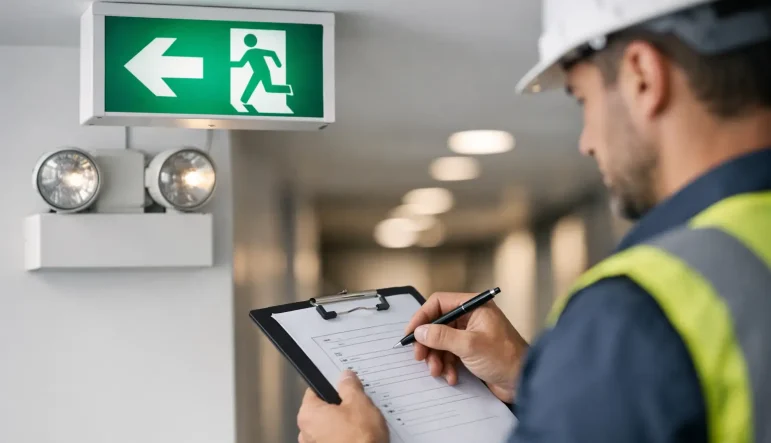
A failed escape light is rarely noticed during normal trading hours. It becomes critical when normal lighting fails, visibility drops and people need to leave without hesitation. Emergency lighting inspection requirements exist to make sure that escape routes, open areas and safety equipment remain visible when they are needed most.
For responsible persons, facilities managers and property owners, this is not simply a matter of pressing a test button. The inspection regime must reflect the building’s fire risk assessment, its emergency lighting design, the type of fittings installed and the risks created by the test itself. A small office, a factory with shift working and a transport facility may follow similar principles, but the practical controls will not be identical.
In England and Wales, the Regulatory Reform (Fire Safety) Order 2005 requires the responsible person to take general fire precautions and ensure that relevant fire safety systems are maintained in an efficient state, in efficient working order and in good repair. Emergency escape lighting is commonly part of those arrangements where people could be placed at risk if normal lighting fails.
Scotland and Northern Ireland operate under their own fire safety legislation, but the underlying duty is comparable: assess the risk, provide appropriate precautions and maintain them properly. For workplaces and other non-domestic premises, this means emergency lighting should be considered as part of the wider fire safety strategy, not treated as an isolated electrical task.
British Standards provide the accepted technical framework used to demonstrate good practice. BS 5266-1 is central to emergency lighting system design, while BS EN 50172 and BS 5266-8 set out expectations for testing, servicing and logging. These standards are not themselves legislation, but following them is a well-established way to support compliance. A different approach may be appropriate in some premises, but it should be justified by the risk assessment and documented by a competent person.
The established testing approach combines regular checks with a longer annual discharge test. The purpose is straightforward: short tests identify obvious faults early, while the annual test proves that batteries can sustain the required emergency duration.
A routine visual inspection should confirm that luminaires, exit signs, charging indicators and test facilities appear sound. Look for physical damage, missing diffuser covers, signs of water ingress, obstruction, incorrect labelling and fittings that are not illuminated or charging as expected.
At intervals of no more than one month, emergency luminaires are normally subjected to a functional test. This involves simulating a failure of the normal supply for a period sufficient to confirm that each fitting operates. The test should not fully discharge the battery. On self-contained fittings, this is often achieved through a local test key or switch. Centrally supplied systems require a controlled test arrangement suited to the installation.
The critical point is that all relevant equipment must operate, not merely the most visible exit sign. This includes emergency lighting in corridors, stairways, final exits, toilets where appropriate, open areas, plant rooms and any high-risk task areas identified by the design.
Once each year, the system should be tested for its full rated duration. Many systems are designed for three hours, but one-hour durations are also used where the fire risk assessment and evacuation arrangements support them. The required duration is determined by the system design and cannot be assumed from the appearance of the fitting.
During the test, normal power to the emergency lighting circuit is simulated as failed for the complete rated period. At the end of that period, the lights should still be operating satisfactorily. Once the normal supply is restored, each unit must recharge correctly.
This test needs planning. A full discharge may leave batteries unable to provide their rated duration again until they have recharged, so it should be carried out when the building is unoccupied or when suitable temporary controls are in place. Testing a busy warehouse, care environment, station area or premises operating overnight without considering that reduced protection can create a new safety risk.
Formal monthly and annual tests do not remove the need for inspection after relevant events. Emergency lighting should be checked after electrical alterations, refurbishment, water damage, impact damage, a prolonged power interruption or a reported fault. Changes to partitions, racking, ceiling layouts or escape routes can also leave an otherwise serviceable lighting system unsuitable for the building’s current use.
A proper inspection considers more than whether a lamp comes on. The engineer or competent in-house tester should assess the condition, operation and suitability of the system against the current premises.
Particular attention should be given to escape route coverage and exit signs. A sign concealed by new signage, a luminaire blocked by stored stock or a fitting that no longer lights a changed route may undermine evacuation even when the unit itself passes a battery test. In industrial and transport-related settings, vibration, dust, temperature extremes and vehicle impact can shorten the life of fittings and require closer attention.
Battery performance is another common issue. Older self-contained units may illuminate during a short test but fail before the required duration is complete. LED upgrades can reduce energy use and maintenance demands, but replacement fittings must still provide the specified emergency performance, appropriate light distribution and compatible test arrangements. Replacing a failed fitting with a standard light fitting is not an acceptable substitute.
For centrally supplied systems, inspection may also include the central battery, charger, distribution equipment, monitoring panel, circuit integrity and fault indications. These installations require a level of knowledge beyond routine lamp replacement, particularly where the system is connected to wider fire alarm, building management or monitoring arrangements.
A fire safety logbook provides evidence that testing has been completed and that faults have been managed. It also gives the next inspector a useful history of recurring failures, battery replacements and changes to the installation. Electronic records can be effective, provided they are accessible and maintained with the same discipline as a paper logbook.
Each entry should record:
Do not record a test as satisfactory if a fault remains outstanding. Where a defect affects an escape route, the responsible person should assess the immediate risk and put suitable interim measures in place until repair is completed. Depending on the premises, this may mean restricting use of an area, providing temporary lighting, increasing supervision or arranging urgent remedial works.
Automatic self-test and addressable emergency lighting systems can reduce the burden of manual routine testing. They can initiate scheduled tests, monitor results and identify individual fitting faults. This is particularly useful in large offices, industrial premises, campuses and infrastructure environments where manual access is difficult.
However, automation does not remove the duty to maintain the system. Someone still needs to review reported failures, ensure repairs are completed, retain records and visually check that building changes have not compromised coverage. A monitor can report a battery fault; it cannot judge whether a newly installed partition has created a dark section of escape route unless the system and risk assessment are reviewed.
If records are absent, fittings are of mixed age, escape routes have changed or repeated faults are appearing, an emergency lighting survey is often more useful than another isolated test. A survey can establish what is installed, identify gaps in coverage, confirm duration requirements and set out a prioritised remedial plan.
This is especially relevant after a change of use. A unit converted from storage to public-facing retail, an office reconfigured for higher occupancy or a residential block with altered common areas may need a revised assessment. Private dwellings are different from common parts in blocks of flats and from workplaces, so the applicable duties and appropriate provision depend on the building and its occupants.
SJB Smart Electricals supports emergency lighting surveys, installation, testing and workforce training across domestic, commercial, industrial and transport-related environments. The objective is not paperwork for its own sake, but dependable emergency lighting that performs properly when normal lighting is no longer available.
A planned inspection programme, accurate records and prompt correction of faults give duty holders something more valuable than a completed checklist: confidence that people can find their way to safety in the conditions the system was installed to address.

Assess the best sectors for electrical training investment, from comme

Citroën has unveiled ë-Berlingo, the latest version of its multi-awa
