York
08:00 AM - 05:00 PM
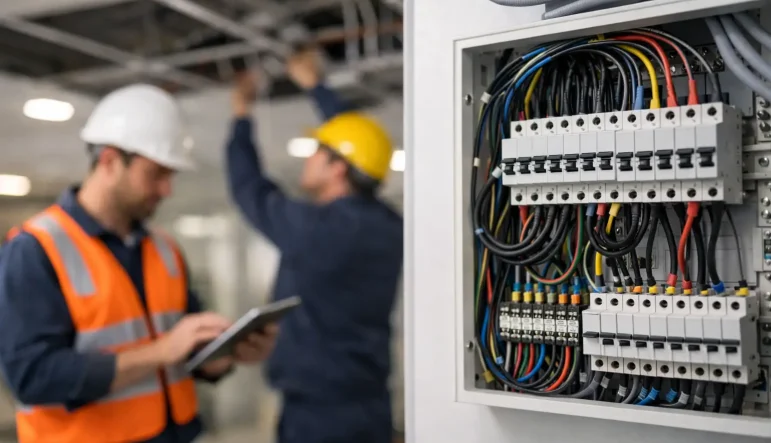
A commercial fit-out can look finished long before the building is ready to use. Lights may be in place, power points fitted and plant connected, but if the electrical work has not been properly designed, installed and tested, the space is not truly operational. That is why commercial electrical installations need more than basic wiring knowledge. They require a clear understanding of safety, compliance, building use and long-term performance.
For property managers, business owners and facilities teams, the real challenge is rarely just getting power from one point to another. It is making sure the installation suits the demands of the site, supports the people using it and stands up to inspection, maintenance and day-to-day load. In commercial settings, mistakes are costly. They disrupt operations, create avoidable risk and often lead to remedial work that could have been prevented at the planning stage.
Commercial electrical installations cover the systems that allow a business premises or public-facing site to function safely and efficiently. That includes incoming power distribution, containment, lighting, emergency lighting, small power, data-related electrical provision, fire alarm interfaces and supplies for specialist equipment. In some settings, it also extends to access control, EV charging, external lighting and support for HVAC and building management systems.
The exact scope depends on the type of building. An office block has different demands from a retail unit, warehouse, school or transport facility. A hospitality venue may need carefully zoned lighting and kitchen supplies, while an industrial site may need heavier loads, three-phase distribution and more durable containment. The work is not interchangeable just because the buildings are all classed as commercial.
That is where experience matters. A contractor needs to understand how each environment is used, what standards apply and where future demand is likely to increase. Installing only for the present requirement can be a false economy if the site is expected to grow, reconfigure or take on additional equipment within a short period.
Good installation begins with good survey work. Before any cables are run or boards are fitted, the site needs to be assessed properly. Existing infrastructure, load requirements, routes, access limitations and compliance considerations all affect the final design. If one of those factors is missed early on, the impact usually appears later as delay, variation cost or reduced performance.
In occupied premises, the design stage also needs to consider continuity of operation. Many commercial clients cannot afford full shutdowns during working hours. Phased works, out-of-hours access and temporary power arrangements may be required. That changes not only the programme but the practical method of installation.
This is also the point at which specification decisions should be made carefully. There is always a balance between budget, durability and performance. A lower-cost option may suit a light-use office tenancy, but the same choice may be unsuitable in a warehouse, transport environment or high-traffic public building. The right answer depends on the site, not on a one-size-fits-all package.
In commercial electrical work, compliance carries operational consequences. Installations must meet the relevant British Standards and current regulations, but they must also satisfy the practical expectations of insurers, landlords, building control, facilities teams and end users. If the system is technically compliant but difficult to maintain, poorly labelled or badly coordinated with other services, it can still become a problem.
Testing and certification are central to this. A commercial installation should be fully inspected, tested and documented so the client has a clear record of what has been installed and how it performs. This is not just for handover. It supports future fault-finding, maintenance planning and any later alterations.
There is also a wider duty to think about how the installation will age. Commercial buildings change hands, layouts change, tenants change and equipment changes. A compliant installation delivered today should not create avoidable confusion for the next contractor or facilities manager six months later.
One of the biggest challenges is coordination. Electrical works rarely happen in isolation. They sit alongside mechanical services, fire protection, ceilings, joinery, security systems and general construction sequencing. On busy projects, poor coordination leads to congested service routes, access issues and repeated rework.
Another challenge is matching the installation to the actual operational pattern of the building. A space might look straightforward on a drawing, but the reality on site can be different. Staff movement, public access, storage patterns and equipment use all affect where power and lighting should go. If the installation is based purely on a plan and not informed by practical use, the result may be technically complete but operationally inconvenient.
Timescale pressure is another common issue. Commercial programmes are often tight because the client is working towards opening dates, tenant occupation or production deadlines. Speed matters, but cutting corners creates risk. A dependable contractor knows where efficiency can be gained and where it cannot. Testing, safe isolation, correct termination and proper documentation cannot be treated as optional extras when the deadline tightens.
Clients do not just need somebody who can install. They need a contractor who can assess, advise and deliver to the standard the building requires. That means looking beyond price alone. Approval status, sector experience and the ability to work in regulated or high-demand environments all carry weight.
A suitable contractor should be comfortable with surveys, design input, installation, testing and client communication. They should also understand that different stakeholders want different levels of detail. A business owner may want a clear explanation of cost and programme, while a facilities lead may focus on certification, maintenance access and system resilience. Both matter.
It is also worth looking at whether the contractor can support the wider competence of the site team. In many organisations, installation is only one part of the relationship. Training and technical guidance can help internal teams operate systems more safely and manage future changes with better understanding. For that reason, businesses such as SJB Smart Electricals bring value not only through delivery on site, but through practical knowledge that supports ongoing operation.
The best commercial installations are the ones that continue to make sense after the contractors have left site. Lighting should support the way the building is actually used. Distribution should allow safe access and future additions. Labelling should be clear. Containment should be suitable for the environment. None of this is glamorous, but all of it affects reliability.
Futureproofing also deserves proper thought. That does not mean overspending on unnecessary capacity. It means making informed allowances where future demand is likely. A board with no room for expansion, routes with no spare capacity or layouts that make later adaptation difficult can increase long-term cost significantly.
Energy performance is another part of the discussion. Commercial clients increasingly want systems that reduce waste, support controls and improve efficiency. That can include LED upgrades, presence detection, timed control, zoned switching and better distribution planning. The right approach depends on the building and the operational priorities. In some sites, energy savings justify early investment. In others, resilience and uptime are the stronger concern.
A well-run commercial electrical project is usually easy to recognise. The survey is thorough, the scope is clear and the programme reflects the realities of the site. Communication is consistent, especially where access, shutdowns or phased works are involved. Health and safety is treated seriously from the outset rather than being revisited after problems emerge.
On site, quality shows in the details. Containment is installed neatly and sensibly. Circuits are identified properly. Testing is carried out at the right stage, not rushed at the end. Snagging is reduced because the work has been supervised and coordinated throughout the programme.
Most importantly, the finished installation works for the client in practice, not just on paper. Staff can use the space effectively, maintenance teams can navigate the system and the building is better prepared for routine operation. That is the standard commercial clients should expect.
Commercial electrical work has a direct effect on safety, continuity and confidence in a building. When it is surveyed properly, designed with care and installed by an approved, experienced contractor, it supports the day-to-day performance of the entire site long after handover.

Learn how to choose electrical survey provider expertise for safe, com

Citroën has unveiled ë-Berlingo, the latest version of its multi-awa
